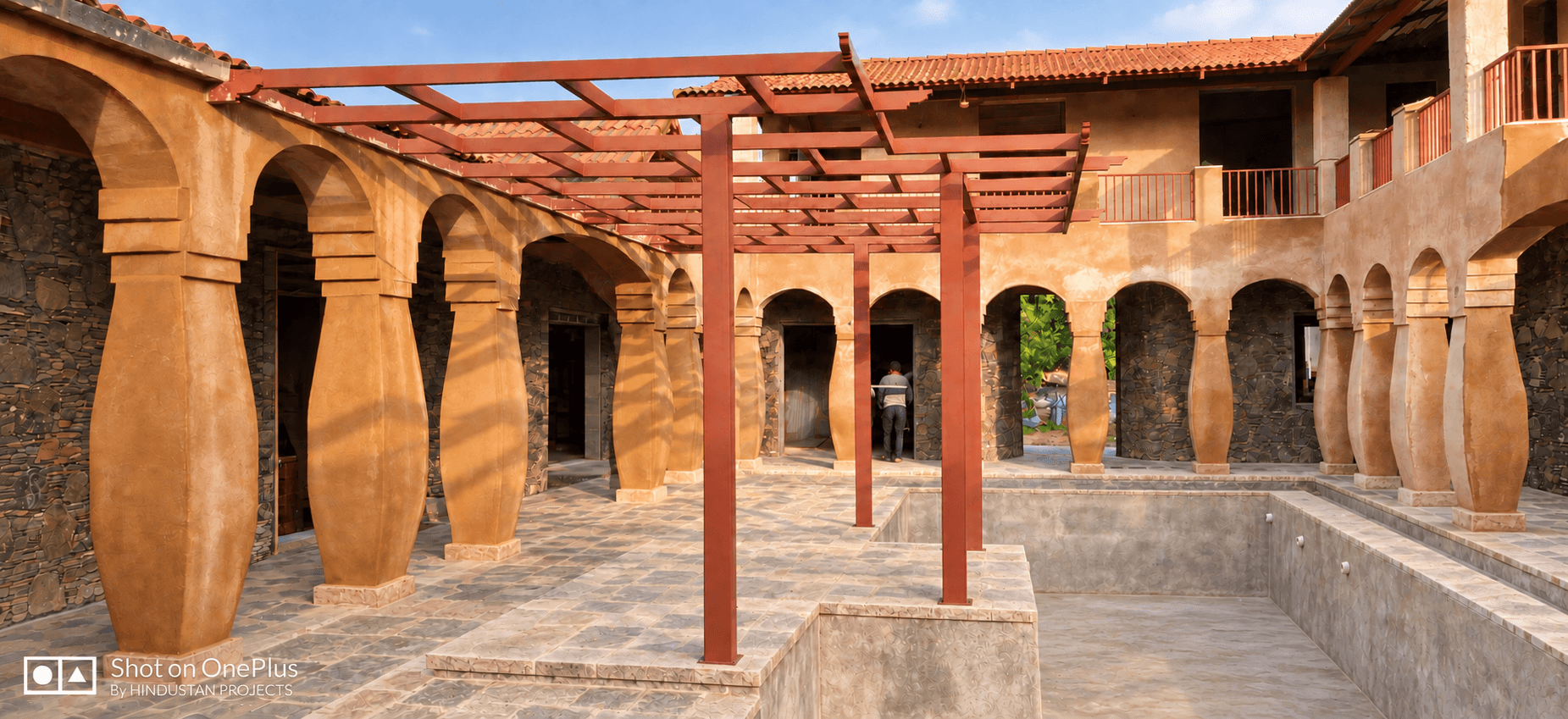
Modern architecture is increasingly rediscovering materials that were used successfully long before synthetic wall coatings became common.
One of those materials is natural lime plaster.
Lime-based finishes have been used in buildings for centuries, including traditional Indian architecture. Today, architects and homeowners are again exploring lime plaster because of its distinctive appearance, vapour-permeable character, compatibility with certain traditional masonry systems and ability to create naturally varied wall surfaces.
For homeowners, architects and designers exploring natural lime plaster in Bhilwara, the material can offer an alternative to conventional wall-finishing systems—but it needs to be specified and applied correctly.
Lime plaster should not be selected simply because it is described as “natural” or “sustainable.”
The type of lime, substrate, wall condition, application method, curing, craftsmanship and intended exposure all matter.
This guide explains what natural lime plaster is, how it differs from conventional finishes, where it can be used, its advantages and limitations, and what should be considered before specifying it for a modern building in Bhilwara.
What Is Natural Lime Plaster?
Natural lime plaster is a mineral-based wall finish in which lime acts as the principal binder.
Depending on the formulation and application, a lime plaster system can contain materials such as:
- Lime binder
- Clean graded sand
- Water
- Mineral pigments
- Suitable natural or mineral additives
- Fibres or other compatible materials where specified
The exact composition depends on whether the plaster is being used as a base coat, finishing coat, decorative finish or restoration material.
Unlike simply choosing a paint colour, lime plaster is a complete material system.
Its performance depends heavily on the correct combination of materials, substrate preparation, layer thickness, curing and workmanship.
Lime Plaster Is Not Just an Old-Fashioned Material
Lime plaster is often associated with heritage buildings, havelis and traditional architecture.
But traditional materials do not necessarily belong only in traditional-looking buildings.
A carefully executed lime finish can work with:
- Contemporary houses
- Minimal interiors
- Courtyard homes
- Farmhouses
- Villas
- Boutique commercial spaces
- Hospitality projects
- Feature walls
- Traditional renovations
The visual result can range from rustic and textured to smooth and restrained.
The key is to use the material as part of the architectural language rather than treating it as a decorative effect added at the end.
Why Is Lime Plaster Becoming Relevant Again?
Modern construction has given designers an enormous range of manufactured finishes.
At the same time, many homeowners are becoming more interested in:
- Natural material palettes
- Mineral finishes
- Traditional craftsmanship
- Passive design
- Climate-responsive architecture
- Materials with less synthetic appearance
- Surfaces with natural variation and depth
Lime plaster fits naturally into many of these design conversations.
Its surface can have subtle tonal variation and material depth that may be difficult to reproduce with conventional flat paint.
However, its renewed popularity should not lead to unrealistic claims.
Lime plaster is not automatically the correct material for every wall or every project.
Understanding Breathability in Lime Plaster
One of the most discussed properties of lime plaster is its vapour permeability, often informally described as “breathability.”
This does not mean that walls literally breathe.
It means that an appropriate lime-based wall system can allow water vapour to move through the finish more readily than many dense or impermeable coatings.
This can be useful in compatible wall assemblies because trapped moisture can contribute to deterioration of certain masonry and finishes.
However, vapour permeability does not make a wall waterproof.
A leaking pipe, failed roof detail, rising damp problem or poorly protected exterior wall still requires the underlying source of moisture to be addressed.
A breathable finish cannot compensate for defective construction.
Natural Lime Plaster vs Cement Plaster
Lime plaster and cement plaster should not be treated as interchangeable materials.
Cement-based plaster is widely used in modern construction because it develops relatively high strength and is familiar to contractors.
Lime-based plaster generally behaves differently.
Depending on its formulation, lime plaster can be:
- More vapour permeable
- More accommodating of certain traditional masonry
- Slower to develop its final properties
- More dependent on skilled application
- Capable of producing naturally varied finishes
Cement plaster can be appropriate for many modern construction situations.
The decision should therefore not be framed as:
Lime is good and cement is bad.
The better question is:
Which plaster system is appropriate for this substrate, exposure, building type and design objective?
Lime Plaster vs Gypsum Plaster
Gypsum plaster is commonly used for smooth internal wall finishes.
It can provide a relatively fast and uniform surface for interior work.
Natural lime plaster offers a different aesthetic and material character.
A lime finish may be preferred when the design requires:
- Natural tonal variation
- Mineral texture
- Traditional material expression
- Softer visual character
- Compatibility with certain lime or traditional masonry systems
Gypsum may be preferred where fast and highly uniform interior finishing is the primary objective.
Material selection should respond to the wall assembly and desired performance rather than trend alone.
Natural Lime Plaster and Sustainable Architecture
Sustainable architecture is not created by selecting one “eco-friendly” material.
A building's environmental performance depends on a much larger system that can include:
- Building orientation
- Shading
- Natural ventilation
- Daylight
- Structural efficiency
- Material quantities
- Material sourcing
- Building lifespan
- Maintenance
- Energy use
- Water use
- Construction waste
Natural lime can form one part of this strategy.
Its potential environmental value depends on factors such as the specific product, manufacturing process, transport distance, mix composition, application system and service life.
Sustainability claims should therefore be evaluated for the actual material being specified rather than assumed simply because a product is described as natural.
Why Lime Plaster Can Suit Modern Indian Homes
Many contemporary homes are moving away from highly polished and visually uniform surfaces.
Architects increasingly use texture and material variation to create depth.
Natural lime plaster can complement:
- Natural stone
- Timber
- Exposed masonry
- Neutral flooring
- Handmade furniture
- Soft lighting
- Courtyards
- Landscape elements
- Earth-toned interiors
The finish can create character without requiring excessive decorative treatment.
This makes it particularly suitable for architecture where the material itself is intended to become part of the visual design.
Lime Plaster for Bhilwara's Climate
Material selection in Bhilwara should consider Rajasthan's hot summers, strong sunlight, dust and seasonal rainfall.
For exterior applications, the plaster system needs to be selected according to factors such as:
- Wall orientation
- Rain exposure
- Roof projections
- Parapet detailing
- Drainage
- Substrate
- Surface preparation
- Final protective treatment where required
Interior lime finishes have different exposure conditions and can generally be easier to control.
Exterior applications require particular attention to detailing.
No plaster should be expected to solve problems caused by poorly designed copings, leaking terraces, defective plumbing or inadequate rainwater management.
Where Can Natural Lime Plaster Be Used?
Depending on the selected system and substrate, lime plaster may be considered for:
- Interior walls
- Selected exterior walls
- Living rooms
- Bedrooms
- Entrance areas
- Staircases
- Courtyard walls
- Feature walls
- Farmhouses
- Villas
- Heritage-inspired properties
- Boutique commercial spaces
- Restoration projects
The suitability of a particular lime system should always be checked for the intended environment.
Lime Plaster for Interior Walls
Interior walls are one of the most attractive applications for natural lime finishes.
The subtle variation of the surface can create a softer atmosphere than a perfectly uniform painted wall.
Interior lime plaster can work particularly well with:
- Warm indirect lighting
- Natural wood
- Stone flooring
- Neutral fabrics
- Minimal furniture
- Handmade objects
- Indoor plants
The wall itself becomes part of the material palette.
This can reduce the need for excessive decorative wall treatments.
Lime Plaster for Exterior Walls
Exterior lime plaster requires more careful specification.
External walls can face:
- Direct sunlight
- Temperature changes
- Wind
- Dust
- Rain
- Splashback
- Building movement
- Maintenance exposure
The complete wall build-up, plaster formulation, thickness, detailing and finishing system should be suitable for these conditions.
Roof edges, parapets, sill details and drainage are particularly important because repeated concentrated water exposure can damage even a well-applied wall finish.
Exterior lime plaster should therefore be considered as part of the complete facade system rather than as an isolated decorative coating.
Lime Plaster for Feature Walls
A homeowner does not necessarily need to use lime plaster throughout the entire building.
It can be introduced selectively.
For example:
- Living room feature wall
- Entrance wall
- Staircase wall
- Courtyard
- Dining area
- Bedroom backdrop
- Meditation room
- Reception space
Selective use can create material contrast while keeping the rest of the interior simpler.
It can also allow the client and contractor to understand the appearance and maintenance of the finish before committing to larger areas.
Natural Texture Is Part of the Character
Conventional painted walls are often judged by how perfectly uniform they appear.
Natural lime finishes may need to be viewed differently.
Depending on the application technique, the finished surface can show:
- Subtle tonal variation
- Trowel movement
- Slight texture
- Natural mottling
- Material depth
- Handmade character
These can be intentional characteristics rather than defects.
A client who expects every square metre to look perfectly identical should discuss expectations with the designer and applicator before selecting this type of finish.
Smooth Lime Plaster vs Textured Lime Plaster
Lime finishes can be developed with different visual characteristics.
Smooth Lime Finish
A smoother finish can suit:
- Contemporary interiors
- Minimal architecture
- Bedrooms
- Living spaces
- Refined feature walls
Textured Lime Finish
A more textured application can suit:
- Courtyards
- Farmhouses
- Rustic-modern interiors
- Exterior feature surfaces
- Traditional architecture
The final finish should ideally be selected through physical samples rather than photographs alone.
Always Make a Sample Before Final Application
One of the most important steps when selecting natural plaster is creating a physical sample.
Digital renders and photographs cannot perfectly communicate:
- Texture
- Colour variation
- Trowel marks
- Light reflection
- Surface depth
- Handmade irregularity
A sample panel should ideally be viewed under the actual project lighting.
For exterior finishes, it should also be evaluated in natural daylight.
Only after reviewing the sample should the final texture and colour direction be approved.
Substrate Preparation Is Critical
A beautiful lime finish cannot compensate for a poorly prepared wall.
Before application, the substrate should be assessed for:
- Loose material
- Dust
- Existing coatings
- Cracks
- Moisture problems
- Surface contamination
- Uneven absorption
- Compatibility
Some modern surfaces may require specific preparation or intermediate layers.
The applicator should follow the requirements of the selected lime system rather than assuming that every wall can receive the same treatment.
Natural Lime Plaster in New Construction
In new construction, lime plaster can be planned as part of the wall system from the beginning.
This makes it easier to coordinate:
- Masonry
- Base plaster
- Electrical chasing
- Plumbing work
- Wall junctions
- Final lime layers
- Lighting
- Finishing sequence
Early planning can also reduce the risk of incompatible materials being applied before the lime finish is considered.
Lime Plaster in Existing Buildings
Renovation projects require more investigation.
Existing walls may contain:
- Paint
- Putty
- Cement plaster
- Damp patches
- Cracks
- Previous repairs
- Incompatible coatings
These conditions should be understood before a new finish is applied.
In some cases, preparation can become a significant part of the work.
Lime Plaster and Moisture Problems
Lime plaster is sometimes marketed as a solution for damp walls.
That claim requires caution.
If moisture is entering because of:
- Plumbing leakage
- Roof leakage
- Failed waterproofing
- Rising damp
- Exterior rain penetration
- Poor drainage
the source should first be identified and addressed.
Changing the plaster alone may not solve the underlying problem.
A more appropriate sequence is:
Identify Moisture Source → Correct the Defect → Allow Appropriate Drying → Select a Compatible Repair and Finish System
Lime Plaster and Cracking
No plaster system can guarantee a completely crack-free building.
Cracks can originate from:
- Structural movement
- Masonry movement
- Junctions between materials
- Poor workmanship
- Incorrect curing
- Excessive layer thickness
- Incompatible substrates
- Building settlement
Lime can accommodate certain small movements differently from rigid cement-rich finishes, depending on the mix and wall system.
However, structural or significant cracks should be investigated rather than simply hidden beneath a decorative finish.
Why Skilled Craftsmanship Matters
Natural lime plaster is highly dependent on workmanship.
The applicator needs to understand:
- Material preparation
- Substrate condition
- Moisture control
- Layer thickness
- Trowel technique
- Timing
- Curing
- Finish development
Two teams using similar raw materials can produce very different results.
For this reason, contractor selection should consider demonstrated experience with lime work rather than only general plastering experience.
How Is Natural Lime Plaster Applied?
The exact application process depends on the selected material system, but a project may broadly involve the following stages.
Step 1 – Assess the Wall
Check the substrate condition, moisture, cracks and existing coatings.
Step 2 – Select the Lime System
Choose an appropriate base and finishing system according to the wall and desired appearance.
Step 3 – Prepare the Surface
Remove loose or incompatible material and prepare the substrate according to the selected system.
Step 4 – Prepare the Mix
Mix the plaster materials using the specified proportions and procedure.
Step 5 – Apply Base Layers
Where required, base coats create a suitable foundation and help correct wall irregularities.
Step 6 – Allow Appropriate Curing
Lime-based materials generally require suitable moisture conditions and sufficient time to develop properly.
Step 7 – Apply the Finish Layer
The final layer creates the desired texture, colour and visual character.
Step 8 – Final Curing and Protection
Fresh work should be protected and cured according to the requirements of the selected material system.
Why Lime Plaster Should Not Be Rushed
Construction schedules often reward speed.
Natural lime work may require a different approach.
Depending on the system, sufficient time may be needed between stages.
Trying to accelerate the process incorrectly can affect:
- Bond
- Surface quality
- Cracking
- Colour
- Final appearance
If a project has an extremely compressed finishing schedule, this should be considered before specifying lime plaster.
Natural Pigments and Lime Finishes
Colour can be introduced into certain lime finishes using compatible pigments.
This allows the wall colour to become integrated with the material rather than depending entirely on a conventional paint film.
Possible visual directions can include:
- Warm white
- Off-white
- Sand
- Beige
- Soft grey
- Earth tones
- Muted terracotta
- Other mineral-inspired shades
The final colour can be influenced by the materials, pigment concentration, application method and lighting.
Physical samples remain important.
Lime Wash and Lime Plaster Are Different
Lime wash and lime plaster are related but different materials.
Lime plaster creates a material layer over the wall.
Lime wash is a much thinner lime-based surface treatment applied over a suitable substrate.
They can sometimes form part of the same compatible finishing system, but they should not be treated as identical products.
The appropriate choice depends on whether the project requires surface build-up, texture, colour or maintenance treatment.
Can Lime Plaster Be Painted?
Compatible coatings can be applied over certain lime plaster systems.
However, the coating needs to be selected carefully.
Applying an unsuitable impermeable coating can change the vapour behaviour of the wall assembly.
Where maintaining a vapour-permeable mineral system is important, compatible mineral or lime-based coatings may be appropriate depending on the product and application.
The technical requirements of the selected plaster and coating system should be followed.
Lime Plaster in Bathrooms and Wet Areas
Lime plaster should not automatically be treated as a substitute for waterproofing.
Bathrooms contain different exposure zones.
A decorative wall away from direct water exposure has very different requirements from the inside of a shower enclosure.
Wet areas require a properly designed waterproofing and finishing system.
If lime plaster is being considered in a bathroom, its location and compatibility with the waterproofing strategy should be evaluated carefully.
Lime Plaster in Kitchens
Kitchen walls face grease, moisture, splashing and regular cleaning.
A lime finish may work well in selected areas, but high-splash zones behind sinks or cooking surfaces may require finishes capable of tolerating more frequent cleaning and direct exposure.
Material selection should therefore follow how each surface will actually be used.
Lime Plaster for Courtyard Architecture
Courtyards are particularly interesting spaces for natural finishes.
Lime plaster can complement:
- Stone
- Brick
- Timber
- Plants
- Water features
- Filtered daylight
- Traditional screens
In contemporary architecture, this combination can create a connection between modern planning and traditional material character.
However, courtyard walls exposed to rain still require appropriate detailing.
Combining Lime Plaster With Natural Stone
Rajasthan has a strong architectural relationship with natural stone.
Lime plaster can visually complement stone because both materials can provide natural texture and tonal variation.
The combination can work effectively in:
- Entrances
- Courtyards
- Facades
- Living spaces
- Staircases
- Boundary features
The design should avoid using too many competing textures simultaneously.
A restrained material palette often creates a stronger architectural result.
Natural Lime Plaster and Modern Minimalism
Minimal architecture does not necessarily require plain white painted walls.
A restrained lime surface can introduce depth while maintaining visual simplicity.
Instead of decorating a room with multiple wall panels and finishes, the designer can allow:
- Proportion
- Daylight
- Shadow
- Texture
- Furniture
- Natural materials
to create the visual character.
This is one reason lime plaster can work effectively in contemporary architecture.
Maintenance of Lime Plaster
Maintenance requirements depend on where the plaster is used and the selected finish.
Interior walls generally experience less environmental stress than exterior walls.
Over time, lime-finished surfaces may develop:
- Marks
- Minor colour variation
- Local wear
- Small imperfections
- Weathering on exterior surfaces
Some owners appreciate this natural ageing.
Others prefer a perfectly uniform appearance.
Expectations should therefore be discussed before the finish is selected.
Can Lime Plaster Be Repaired?
Localized repairs may be possible depending on the plaster system and type of damage.
However, perfectly matching an aged handcrafted surface can be difficult.
A repaired area may initially show differences in:
- Colour
- Texture
- Tone
- Surface absorption
These differences may sometimes become less noticeable as the surface ages.
For visually important areas, the repair method should ideally be tested before larger work is carried out.
Is Natural Lime Plaster Expensive?
There is no single rate that applies to every lime plaster project.
The cost can depend on:
- Type of lime system
- Number of coats
- Existing wall condition
- Surface preparation
- Finish complexity
- Pigments
- Labour skill
- Wall height
- Scaffolding
- Interior or exterior application
- Project quantity
- Material sourcing
A simple finish over a well-prepared substrate and a highly specialized decorative lime finish can have very different costs.
A quotation should therefore define the complete application system rather than provide only a vague per-square-foot rate.
Compare Complete Wall Systems, Not Just Material Prices
When comparing conventional and natural wall finishes, homeowners should consider more than the cost of the raw plaster.
The comparison may need to include:
- Base preparation
- Number of coats
- Putty requirements
- Paint requirements
- Skilled labour
- Maintenance
- Repairability
- Desired visual finish
A material that appears expensive based only on its raw-material price may replace other finishing stages.
Another system may require multiple separate products.
The complete wall assembly provides a more useful basis for comparison.
Common Lime Plaster Mistakes to Avoid
Choosing Lime Only Because It Is Trending
Material selection should be based on architecture, performance and client expectations.
Applying It Over an Unsuitable Surface
Substrate compatibility matters.
Ignoring Existing Dampness
A decorative finish will not repair a leaking building.
Expecting Perfect Uniformity
Natural variation can be part of the material's character.
Skipping the Sample Panel
Texture and colour should ideally be approved physically.
Using an Inexperienced Applicator
Lime workmanship requires appropriate skill and understanding.
Rushing the Curing Process
Application and curing should follow the selected system.
Ignoring Exterior Water Detailing
Plaster cannot compensate for defective parapets, sills, terrace edges or drainage.
Treating Lime Plaster as Waterproofing
Lime plaster is not automatically a substitute for a properly designed waterproofing system.
Selecting Materials Without Architectural Coordination
The wall finish should work with flooring, stone, timber, lighting and the overall design.
How to Choose Natural Lime Plaster for Your Bhilwara Home
Before finalizing lime plaster, discuss the following with your architect, designer or applicator:
- Where will the plaster be used?
- Is the application interior or exterior?
- What is the existing substrate?
- Is the wall new or old?
- Are there moisture problems?
- What texture is required?
- What colour is intended?
- Is a sample panel included?
- How many coats are proposed?
- What curing process is required?
- What maintenance should be expected?
- Does the contractor have previous lime-work experience?
The objective should be to select a complete and compatible system rather than simply purchase a product labelled “lime plaster.”
Natural Lime Plaster and Interior Design
Wall finishes should be coordinated with the complete interior.
A warm lime wall may interact beautifully with timber, but the final result also depends on:
- Flooring
- Furniture
- Lighting temperature
- Curtains
- Stone
- Metal finishes
- Ceiling treatment
- Natural daylight
This is why material samples should ideally be reviewed together.
A successful interior is created through relationships between materials rather than isolated product selections.
Natural Lime Plaster and Exterior Design
On the exterior, lime plaster becomes part of the building facade.
Its colour and texture should coordinate with:
- Building proportions
- Windows
- Balconies
- Stone
- Screens
- Parapets
- Boundary walls
- Landscape
- Exterior lighting
The finish should also be considered alongside practical factors such as sunlight, rain exposure and maintenance.
Exterior material selection should therefore begin during facade design rather than after construction is complete.
Architecture Should Decide the Material—Not Social Media
Material trends change quickly.
A finish that looks impressive in a photograph may not suit every building.
Before selecting natural lime plaster, consider:
- Architectural style
- Wall construction
- Climate exposure
- Maintenance expectations
- Available craftsmanship
- Budget
- Desired ageing
- Interior palette
The best material is not necessarily the most fashionable material.
It is the one that fits the building.
Natural Lime Plaster in Bhilwara With Hindustan Projects (HiPRO)
Hindustan Projects (HiPRO) provides architecture, construction, interior and exterior design services from Bhilwara, Rajasthan.
For projects where natural or textured wall finishes are being considered, material selection can be coordinated with the overall architectural and interior design according to the project scope.
This can include considering how wall finishes interact with natural light, flooring, stone, cabinetry, facade elements and other materials.
For exterior applications, the finish should also be coordinated with facade geometry, weather exposure, drainage and long-term maintenance requirements.
The objective is not simply to add a fashionable texture.
It is to select a material that supports the architecture and can be executed appropriately on site.
Why Material Selection Should Happen Early
Wall finishes are often selected near the end of construction.
Natural materials can benefit from much earlier planning.
If lime plaster is being considered from the beginning, the project team can coordinate:
- Substrate
- Base plaster
- Electrical chasing
- Plumbing work
- Wall junctions
- Lighting
- Sample panels
- Finish thickness
- Construction sequence
This can reduce the need to force a specialized finish onto a wall system that was never prepared for it.
Final Thoughts
Natural lime plaster represents an interesting meeting point between traditional building knowledge and contemporary architecture.
For homeowners and architects considering natural lime plaster in Bhilwara, its appeal goes beyond simply creating a textured wall.
A well-designed lime finish can introduce material depth, natural variation and distinctive architectural character.
But good results depend on more than the material itself.
The substrate needs to be suitable.
Moisture problems need to be addressed.
The plaster system needs to be selected correctly.
The applicator needs appropriate experience.
Samples need to be approved.
And the finish needs to be coordinated with the architecture around it.
Natural materials work best when they are understood—not romanticized.
Used thoughtfully, lime plaster can become more than a decorative finish.
It can become part of the architectural identity of the building.