Planning a construction project involves more than choosing a design and hiring a contractor. Before work begins, it is important to understand what needs to be built, how much work is involved, which materials and resources may be required, and how the expected costs will be assessed.
This is where a Bill of Quantities (BOQ) becomes useful.
A BOQ is a structured document that lists construction work items, their descriptions, units of measurement and quantities. Depending on the project and procurement method, it may also include rates and amounts for each item. It helps project owners, contractors, consultants and procurement teams understand the scope of work and evaluate costs on a more consistent basis.
In this guide, we explain what a BOQ means in construction, what it contains, how quantities are calculated, how it differs from an estimate or quotation, and how to use it for better construction budget planning.
1. What Is a BOQ in Construction?
BOQ stands for Bill of Quantities. It is a document that identifies and quantifies the items of work required for a construction project, generally based on drawings, specifications and defined measurement rules.
A typical BOQ may contain:
- Item number
- Description of work
- Unit of measurement
- Quantity
- Rate per unit
- Total amount for the item
- Remarks or references to specifications
For example, a BOQ for a building project might include excavation, concrete, reinforcement steel, masonry, plastering, flooring, painting, plumbing and electrical work.
The exact items depend on the project scope. A small residential building will have a different BOQ from a commercial building, industrial shed or infrastructure project.
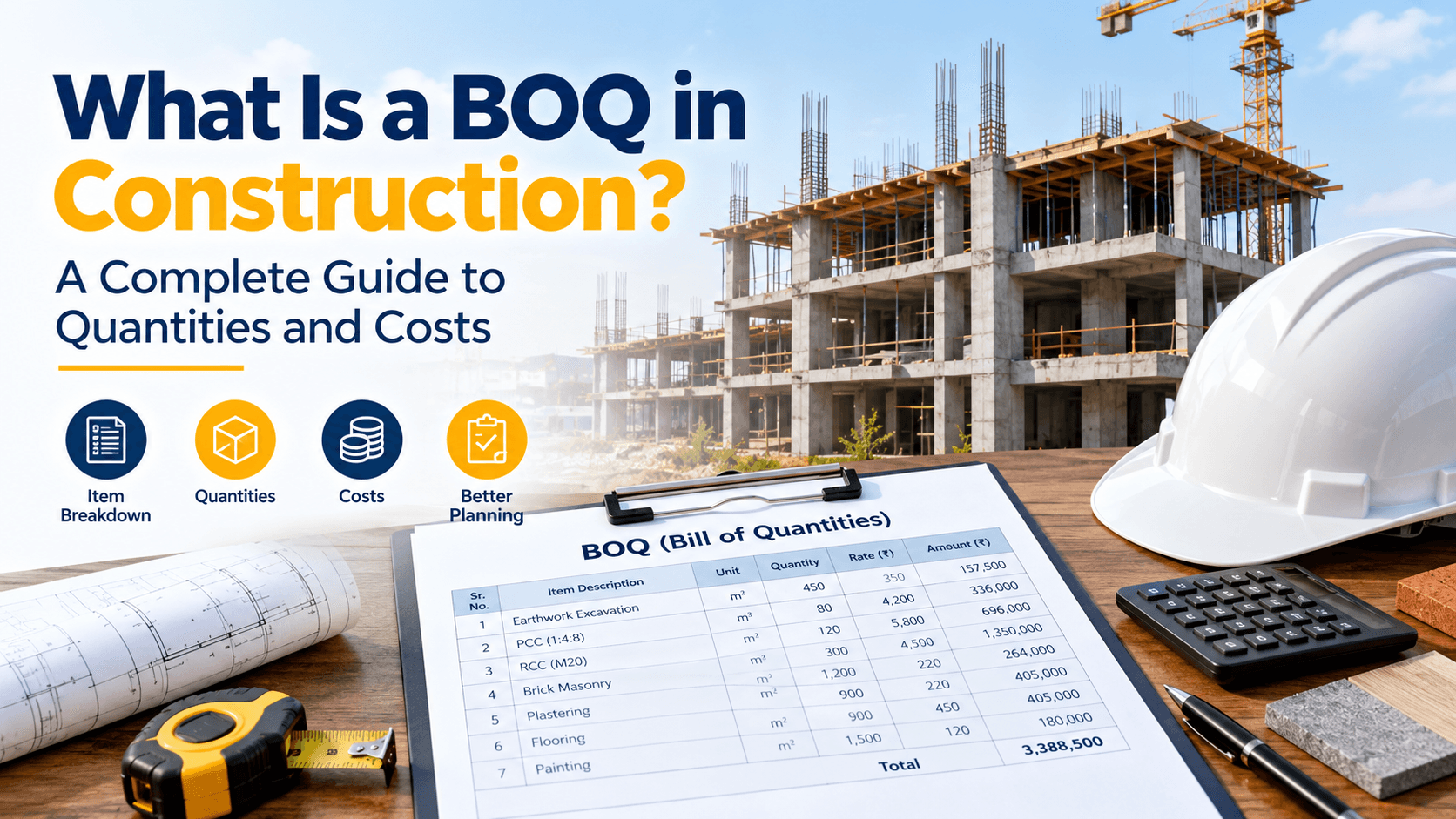
Simple BOQ example
The following table is a simplified illustration of how a BOQ may be structured. The quantities and rates are hypothetical examples for explaining the format, not a construction quotation or recommended market prices.
| Item | Description | Unit | Quantity | Illustrative rate | Illustrative amount |
|---|---|---|---|---|---|
| 1 | Excavation in specified soil | m³ | 20 | ₹300 | ₹6,000 |
| 2 | Concrete work for a defined item | m³ | 10 | ₹5,000 | ₹50,000 |
| 3 | Masonry work | m³ | 15 | ₹4,000 | ₹60,000 |
| Illustrative total | ₹1,16,000 |
In an actual BOQ, each description must define the work sufficiently for consistent measurement and pricing. Rates must be obtained for the relevant location, specification, date and scope.
A BOQ is not simply a list of materials. It is a structured breakdown of construction work and its measured quantities. Depending on the format, it may include labour, materials, equipment or other cost components within the rate—or these may be assessed separately.
2. Why Is a BOQ Important in Construction?
A well-prepared BOQ can make construction planning more organised by giving the project team a common reference for quantities and work items.
2.1 Better budget planning
A BOQ helps identify the quantities of work that need to be priced. When suitable rates are applied, the project team can prepare an item-wise cost estimate.
This makes it easier to identify major cost components, review design decisions and investigate significant cost changes.
2.2 More consistent contractor quotations
When contractors receive the same BOQ, drawings and specifications, their quotations can be compared against a common scope.
Without a shared scope, one contractor may include an item that another excludes. The lowest headline price may therefore not represent the lowest cost for equivalent work.
2.3 Improved material and procurement planning
Measured quantities can help the team plan purchases, deliveries, storage and work sequences. However, procurement quantities may need separate allowances for wastage, cutting, packaging, breakage and supplier-specific order sizes.
2.4 Progress measurement and payment assessment
Depending on the contract, BOQ items can support the measurement of completed work and the assessment of interim payments.
The contract must specify how work is measured, what evidence is required, and how variations or changes are handled. A BOQ alone does not determine payment entitlement.
2.5 Cost monitoring during construction
Comparing planned quantities and costs with actual progress can help identify variations. The team can investigate whether a change results from revised design, site conditions, additional work, rate differences or measurement assumptions.
2.6 Clearer communication
A common itemised document can reduce ambiguity between the owner, designer, estimator, contractor and procurement team.
The benefit depends on clear descriptions, coordinated documents and a process for recording revisions.
3. What Does a Construction BOQ Include?
The contents vary by project, but most detailed BOQs include several common elements.
Item number
Each item receives a unique reference number. This helps with quotation comparison, measurement records, payment statements and revision tracking.
Description of work
The description explains what is to be provided or executed. It may specify the material, grade, dimensions, location, finish, workmanship requirements and relevant drawing or specification reference.
Vague descriptions can cause inconsistent pricing and disputes.
Unit of measurement
Every item needs a suitable unit. Common examples include:
- Cubic metre (m³) for many volume-based items
- Square metre (m²) for many surface-area items
- Running metre (m) for measured lengths
- Kilogram or tonne for measured weight
- Number (No.) for countable items
- Lump sum (LS) for a defined package where appropriate
The applicable measurement method must follow the project specifications, contract requirements or adopted standard.
Quantity
The quantity represents the measured amount of work. It should be traceable to drawings, dimensions, schedules or documented assumptions.
Rate
The rate is the amount assigned to one unit of work. It may include materials, labour, equipment, transport, overheads and profit, depending on the pricing rules and contract.
Amount
For a conventionally priced BOQ item, the amount is generally calculated as:
Item amount = Quantity × Rate
For example, if the measured quantity is 50 m² and the agreed rate is ₹800 per m², the item amount is ₹40,000.
This calculation is straightforward, but its accuracy depends on the quantity, the rate basis and the work included in the description.
Remarks and references
Remarks may identify the drawing, specification section, assumptions, exclusions or other information needed to interpret an item.
For complex projects, these references are especially useful when drawings or specifications are revised.
4. What Is the Difference Between a BOQ, a Cost Estimate and a Quotation?
These terms are related, but they are not interchangeable.
| Document | Main purpose | Typical contents |
|---|---|---|
| BOQ | Quantifies defined construction work | Item descriptions, units and quantities; rates and amounts where included |
| Cost estimate | Forecasts the expected project cost | Quantities, assumed or assessed rates, allowances and applicable cost components |
| Contractor quotation | States a contractor's proposed price and commercial terms | Price, scope, inclusions, exclusions, validity and payment terms |
| Material take-off | Identifies quantities of specified materials from drawings or other project information | Material descriptions, dimensions and calculated quantities |
| Invoice or bill | Records an amount being claimed or billed | Work or goods supplied, quantities where relevant, prices and amount due |
BOQ vs cost estimate
A BOQ establishes the measured work items and quantities. A cost estimate uses quantities and suitable rates or other estimating methods to forecast the cost.
A BOQ may include rates and amounts, so it can also form part of an estimate. The difference is the purpose of the document, not necessarily its appearance.
BOQ vs contractor quotation
The BOQ helps define the work to be priced. The quotation communicates a contractor's proposed commercial offer for a specified scope.
A quotation may include items that are not in the BOQ, or exclude items that another contractor includes. Always review the scope, assumptions, taxes, provisional sums, exclusions and commercial terms before comparing prices.
BOQ vs material take-off
A material take-off focuses on quantities of materials derived from available project information. A BOQ generally organises measurable construction work items, which may include work processes and composite activities rather than just individual materials.
The documents can overlap, but they serve different purposes.
5. How Is a BOQ Prepared?
BOQ preparation follows a systematic process. The exact method depends on the project size, available information, measurement rules and procurement requirements.
Step 1: Collect drawings and specifications
Start with the latest available architectural, structural and services drawings, along with the project specifications.
Check that the documents are coordinated and identify missing information. If drawings conflict or important details are absent, record the issue rather than silently assuming a solution.
Step 2: Define the scope of work
Identify what the BOQ must cover. For a building, the scope may include site preparation, foundations, structural work, masonry, finishes, plumbing, electrical work, external development and other specified items.
Clarify exclusions and any provisional or undefined work.
Step 3: Divide the work into sections
Group items into logical sections, such as:
- Site preparation and earthwork
- Concrete and reinforcement
- Masonry
- Plastering and finishes
- Doors and windows
- Plumbing and sanitary work
- Electrical work
- External works
This structure makes the document easier to review and price.
Step 4: Measure quantities
Take dimensions from the drawings, schedules or verified site information. Apply the relevant measurement rules and record calculations.
For example, a wall's gross area may be calculated from its length multiplied by its height. Deductions for openings and other adjustments depend on the applicable measurement rules and item description.
Step 5: Prepare clear item descriptions
Descriptions should state the required work and its specification sufficiently to support consistent measurement and pricing.
Avoid generic entries such as “concrete work” or “finishing work” when different grades, locations or methods need separate pricing.
Step 6: Assign units and quantities
Choose the unit appropriate to each item and record the measured quantity. Check units carefully: mixing metres with millimetres or square metres with cubic metres can create substantial errors.
Step 7: Apply rates, if required
Rates may be developed using current supplier quotations, labour inputs, equipment requirements, transport, local conditions, applicable schedule-of-rates references and the contractor's pricing basis.
The rate must correspond to the item description and location. An old or unrelated rate should not be treated as a reliable current price.
Step 8: Check totals and assumptions
Verify arithmetic, units, formulas, duplicate items, omitted scope and consistency between the BOQ and project documents.
Record assumptions, exclusions and unresolved details so they can be reviewed before tendering or construction.
Step 9: Issue and control revisions
Include a document date, revision identifier and references to the drawings or specifications used. When the design changes, update affected quantities and communicate the revision to the relevant parties.
A BOQ should not be treated as permanently accurate if the underlying design or scope changes.
6. How Are Construction Quantities Calculated?
Quantity calculation depends on the geometry of the work and the applicable measurement rules. The following formulas are simplified examples for understanding basic measurement principles.
Area calculation
For a rectangular surface:
Area = Length × Height
If a wall is 5 m long and 3 m high:
5 m × 3 m = 15 m²
Whether openings are deducted depends on the BOQ measurement rules and the specific item.
Volume calculation
For a rectangular volume:
Volume = Length × Width × Height
If a defined rectangular excavation is 4 m long, 2 m wide and 1.5 m deep:
4 m × 2 m × 1.5 m = 12 m³
Actual excavation measurement must account for the designed dimensions, site conditions and relevant measurement rules.
Quantity by length
For an item measured along a line, such as a specified pipe or linear feature, the measured length may be recorded in metres.
The BOQ description must define what is included, such as fittings, joints, supports or related work, rather than assuming every component is covered by the length rate.
Quantity by weight
Steel or other materials may be measured by weight when the specification and measurement method require it. Reinforcement quantities should be derived from the approved bar details or schedules using the appropriate method, not estimated solely from the building's floor area.
Quantity by number
Doors, windows, fixtures or equipment may be measured by count where that is the specified unit. Different sizes, ratings or specifications may require separate items.
Important: These examples explain basic arithmetic. They are not a substitute for the applicable measurement standard, approved drawings or project-specific quantity calculations.
7. Common BOQ Sections in a Building Project
A building BOQ may be organised into sections such as the following. The actual structure depends on the scope and contract.
Civil and structural works
This may include excavation, filling, concrete, reinforcement, formwork, masonry and other specified structural or civil work.
Architectural finishes
This section may cover plastering, flooring, skirting, painting, cladding, ceilings and other finishes.
Doors and windows
Items may include frames, shutters, glazing, hardware, installation and associated finishing work, with descriptions specific enough for pricing.
Plumbing and sanitary works
This may include pipework, fittings, valves, sanitary fixtures, water storage and specified drainage systems.
Electrical works
Items may cover wiring, conduits, distribution boards, switches, sockets, lighting points, fixtures, earthing and other defined electrical work.
External development
Depending on the project, this can include paving, boundary walls, gates, drainage, landscaping and other site works.
Preliminaries and other cost items
Some BOQs include preliminaries, temporary works, site facilities, testing or other defined cost items. Their treatment depends on the pricing structure and contract.
Make sure the BOQ clearly identifies whether a cost is included within item rates, listed separately, provisional or excluded. This helps avoid accidental double counting or gaps in the tender scope.
8. How Does a BOQ Help Compare Contractor Quotations?
A BOQ is especially useful when more than one contractor is invited to price the same scope.
Use the following process:
- 01.Issue the same current drawings, specifications and BOQ to each bidder.
- 02.Ask contractors to identify any qualifications, exclusions or alternative proposals.
- 03.Check that all required items have been priced or clearly identified as unpriced.
- 04.Compare rates and total amounts item by item.
- 05.Investigate large differences in rates or quantities.
- 06.Review the contractor's proposed materials, workmanship, programme and payment terms.
- 07.Confirm how variations and additional work will be valued.
- 08.Document the final agreed scope and commercial basis.
The lowest total is not always the best-value offer. A quotation may appear cheaper because of missing work, lower specifications, omitted preliminaries or assumptions that later lead to additional costs.
For a fair comparison, ensure the bidders are pricing equivalent work on equivalent terms.
9. Common BOQ Mistakes to Avoid
Using outdated drawings
If the BOQ is based on superseded drawings, quantities may no longer match the intended design.
Better approach: Record drawing references and revisions, and update the BOQ when relevant changes occur.
Vague descriptions
An unclear item can be interpreted differently by different bidders.
Better approach: Define the material, grade, finish, location, installation and relevant specification where necessary.
Incorrect units
A unit error can distort a quantity or price.
Better approach: Use consistent units and check calculations and formulas.
Omitting important work
Incomplete scope can result in additional quotations, variations or disputes.
Better approach: Review the BOQ against the drawings, specifications, schedules and intended project scope.
Double-counting items
A component may be included in a composite rate and also listed separately.
Better approach: Define rate inclusions and check overlaps between sections.
Applying unsuitable rates
A rate from another city, project, date or specification may not reflect the current work.
Better approach: Use relevant and current pricing information and state the assumptions behind the estimate.
Ignoring wastage and procurement requirements
Measured work quantities do not always equal the quantity that must be ordered.
Better approach: Distinguish measured BOQ quantities from procurement quantities and apply justified allowances where required.
Failing to record changes
Design revisions can make the original BOQ inaccurate.
Better approach: Maintain a revision log and document approved changes and their cost implications.
10. BOQ for House Construction: What Should Homeowners Check?
Homeowners do not need to prepare every quantity personally, but they should understand the document well enough to ask informed questions.
Before approving a house-construction BOQ, check the following:
- Does it cover the agreed scope of work?
- Are the drawings and specifications clearly identified?
- Are the quantities and units understandable?
- Are material grades, brands or performance requirements defined where necessary?
- Are labour and material inclusions clear?
- Are plumbing, electrical and finishing items covered?
- Are transport, scaffolding, temporary works and disposal included where applicable?
- Are taxes, overheads, profit, contingencies and other cost items treated clearly?
- Are exclusions and provisional items listed?
- Does the contractor explain how variations will be priced?
- Are payment milestones and measurement procedures documented in the contract?
- Is there a process for approving changes before extra work proceeds?
For a residential project, a BOQ should be read alongside the construction agreement, drawings, specifications and payment terms. It should not be used as a substitute for these documents.
11. How Hindustan Projects Can Support BOQ and Cost Planning
Preparing a useful BOQ requires more than entering quantities into a spreadsheet. The document should reflect the defined scope, current drawings, appropriate measurement methods and a consistent basis for pricing.
Hindustan Projects (HiPRO) provides construction-related planning and engineering services. Depending on the project's requirements and the services confirmed by the team, relevant support may include construction cost estimation, BOQ preparation, structural engineering coordination and project planning.
Explore the relevant service pages:
- Construction Cost Estimation and BOQ
- Structural Engineering and Analysis
- Architecture and Planning
- Project Management Consultancy
If you are planning a residential, commercial or industrial project, discuss the available drawings, project scope, location and intended level of cost detail before requesting an estimate.
12. Final Thoughts
A Bill of Quantities is an important tool for organising construction work into measurable items and, where rates are included, assessing their cost. It can support budgeting, tender comparison, procurement planning, progress measurement and cost monitoring.
However, the document is only as useful as its underlying drawings, specifications, quantities, measurement rules and pricing assumptions. Missing information, unclear descriptions or outdated rates can reduce its reliability.
Before starting construction, define the scope, coordinate the drawings, prepare or review the BOQ, compare quotations on the same basis and document how variations will be managed.
Planning a construction project? Contact Hindustan Projects to discuss your cost-estimation and BOQ requirements.
Disclaimer: This article provides general construction-planning information. Actual quantities, rates, contract provisions and payment procedures depend on project documents, applicable measurement rules, location and agreed terms. Obtain project-specific professional advice where needed.