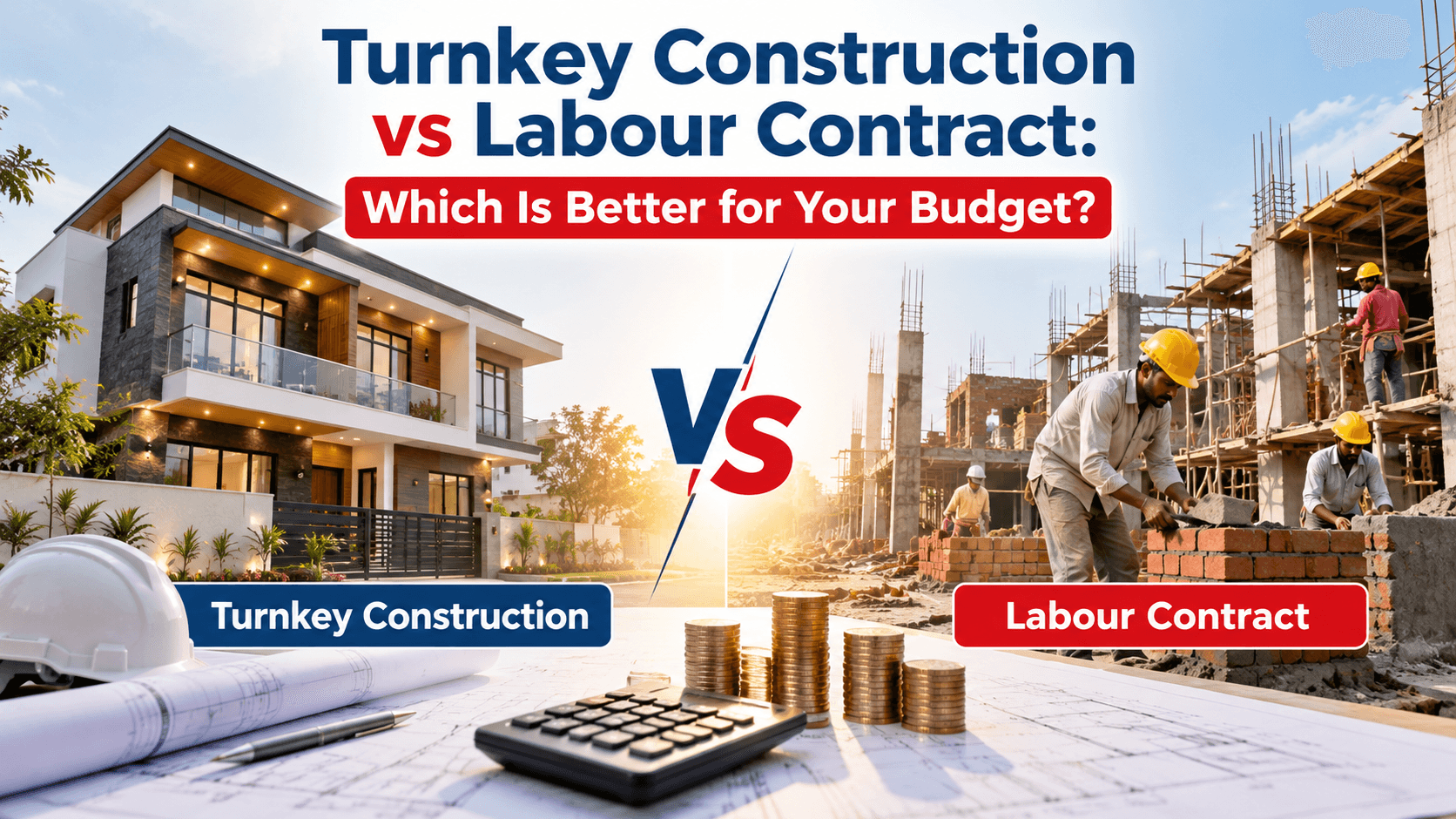
Building your own home is a major financial decision. Before construction begins, homeowners must decide not only what kind of house they want but also how they want the construction work to be managed.
One of the most common questions is whether to choose turnkey construction or a labour contract. Both approaches can be suitable, but they distribute responsibilities, expenses, and risks differently.
Under a typical labour contract, the homeowner purchases most construction materials while the contractor provides labour for the agreed work. Under a turnkey arrangement, the contractor generally manages both materials and labour for a clearly defined construction scope.
However, the cheapest-looking quotation is not always the most economical choice. Material wastage, transportation, site supervision, delays, quality checks, and excluded work can all affect the final budget.
In this guide, we explain the differences between turnkey construction and labour contracts, compare their budget implications, and help you decide which approach may suit your home construction project in Bhilwara or elsewhere in Rajasthan.
What Is Turnkey Construction?
Turnkey construction is a construction arrangement in which one contractor takes responsibility for delivering an agreed scope of work, usually including construction materials, labour, coordination, and specified finishing work.
The homeowner and contractor agree on the design, specifications, price, timeline, payment schedule, and scope before work begins. The contractor then manages the included activities and coordinates the people and resources needed to complete the project.
Depending on the agreement, a turnkey house construction package may include:
- Construction materials such as cement, steel, bricks, and aggregates
- Labour and site execution
- Foundation, structural work, and masonry
- Plumbing and electrical work
- Plastering, flooring, and painting
- Doors, windows, and specified fittings
- Procurement and coordination of subcontractors
- Site supervision and progress updates
- Final checks and handover of the agreed work
These inclusions are not automatic. Some turnkey contracts cover only civil construction, while others include more extensive finishing or design services. Items such as architectural drawings, approvals, compound walls, modular kitchens, wardrobes, appliances, and landscaping may be excluded or separately priced.
The written scope of work—not just the term “turnkey”—determines what you receive.
Advantages of Turnkey Construction
1. One main point of responsibility
A single contractor manages the activities covered by the agreement. This can reduce the burden of coordinating separate material suppliers and construction teams.
2. More predictable budgeting
When the design and specifications are sufficiently detailed, a clearly priced turnkey agreement can make it easier to plan the expected construction expenditure. Changes to the design, quantities, or selected materials may still increase the cost.
3. Less day-to-day involvement
Turnkey construction can suit homeowners who have full-time jobs, live away from the construction site, or cannot regularly manage material deliveries and workers.
4. Coordinated execution
When the contractor manages procurement and multiple trades, materials and work schedules can be coordinated more efficiently. Actual performance depends on the contractor's planning and site management.
5. Defined material specifications
A detailed agreement can list material brands, grades, product ranges, and finishing standards. This helps the homeowner understand what is included and reduces the risk of misunderstandings.
Disadvantages of Turnkey Construction
- The initial quotation may appear higher because it includes materials, labour, and coordination.
- You may have less direct control over day-to-day purchasing decisions.
- Poorly defined specifications can lead to disagreements over material quality or finishing.
- Work outside the agreed scope may involve additional charges.
- The outcome depends significantly on the contractor's reliability and quality-control practices.
Turnkey construction can be a practical choice, but only when the contractor, quotation, specifications, and contract terms are carefully evaluated.
What Is a Labour Contract?
A labour contract is an arrangement in which a contractor provides workers to carry out the agreed construction activities, while the homeowner generally purchases and supplies the construction materials.
Depending on the agreement, labour may be priced per square foot, per unit of work, or on another agreed measurement basis. The quotation should clearly state how quantities are measured and which activities are included.
Under a typical labour contract, the homeowner may be responsible for purchasing or arranging materials such as:
- Cement and steel
- Sand, aggregates, and bricks or blocks
- Tiles and stone
- Plumbing pipes and fittings
- Electrical wires, conduits, and accessories
- Doors, windows, and hardware
- Paint and finishing materials
- Sanitaryware and other fixtures
The exact division of responsibility varies. Equipment, scaffolding, shuttering, curing, site cleaning, material handling, supervision, and specialist work should also be addressed in the written agreement rather than assumed.
Advantages of a Labour Contract
1. Greater control over material purchases
You can compare suppliers, review quotations, and choose products according to your preferences and budget.
2. Direct visibility of material expenses
Since you purchase materials yourself, you can track supplier invoices and understand how much you spend on each category.
3. Flexibility in material selection
You can make purchasing decisions directly, subject to the approved design and technical specifications. However, changes should be discussed with your architect or engineer when they affect technical performance.
4. Potential savings through effective purchasing
If you have construction experience, reliable suppliers, suitable storage, and time to coordinate deliveries, you may be able to manage procurement efficiently.
5. More direct involvement in decisions
A labour contract may suit homeowners who want to remain closely involved in the construction process and monitor the work themselves or through an appointed professional.
Disadvantages of a Labour Contract
- You must devote time to purchasing and arranging materials.
- Incorrect quantities or late deliveries can interrupt work.
- Comparing suppliers and tracking invoices requires organisation.
- Material wastage and storage problems can affect the budget.
- Separate vendors and trades need to be coordinated.
- You may need to arrange independent site supervision and quality checks.
A labour contract can offer control, but that control comes with responsibility. It works best when the homeowner has the time, knowledge, and support needed to manage the process.
Turnkey Construction vs Labour Contract: Key Differences
The following table summarises how the two arrangements usually compare. Actual responsibilities depend on the signed agreement.
| Comparison Factor | Turnkey Construction | Labour Contract |
|---|---|---|
| Construction materials | Usually managed by the contractor for included items | Usually purchased by the homeowner |
| Labour | Managed by the contractor | Provided under the labour agreement |
| Material procurement | Primarily contractor-managed | Primarily homeowner-managed |
| Supplier coordination | Usually handled by the contractor | Usually handled by the homeowner |
| Direct purchasing control | Depends on the approval process | Generally higher |
| Day-to-day involvement | Usually lower | Usually higher |
| Budget visibility | Depends on quotation detail and contract terms | Direct material invoices can improve visibility |
| Cost predictability | Can be higher with a detailed, fixed-scope agreement | Depends on procurement, quantities, labour rates, and coordination |
| Site supervision | Defined by the turnkey scope | Must be clearly allocated |
| Main budget risk | Exclusions, variations, and unclear specifications | Wastage, purchasing decisions, delays, and coordination |
| Suitable for | Owners who prefer broader contractor responsibility | Owners who want more purchasing control and can manage the work |
The key difference is not simply the quoted price. It is who manages the work, who purchases materials, and who carries responsibility when something changes or goes wrong.
Which Is Cheaper: Turnkey Construction or Labour Contract?
There is no universal answer. A labour contract may have a lower initial quotation because the material cost is not included. However, the homeowner must still pay for the materials, transport, handling, and other expenses needed to complete the house.
A turnkey quotation may include more of these expenses in one price, making the initial figure higher but potentially simplifying budget management.
To compare both options fairly, calculate the total expected cost of completing the same scope of work.
Example: Comparing Two Construction Proposals
Imagine you receive two proposals for the same house.
Proposal A: Labour contract
- Labour charges: ₹6,00,000
- Construction materials: ₹12,00,000
- Transport, handling, and other owner-managed expenses: ₹60,000
- Additional supervision or coordination costs: ₹40,000
Illustrative total: ₹19,00,000
Proposal B: Turnkey construction
- Contractor's quotation for the same agreed scope: ₹19,50,000
Illustrative total: ₹19,50,000
In this hypothetical example, the labour-contract arrangement is ₹50,000 lower before considering any differences in quality, exclusions, delays, or unforeseen work.
These figures are only an example to demonstrate the comparison method. They are not current construction rates or a quotation for a house in Bhilwara.
The comparison may change if material prices rise, the homeowner spends more on transport or wastage, or the turnkey quotation excludes important work. Similarly, a well-managed labour contract may be more economical when the owner can source materials effectively.
The better option is the one that delivers the required quality and complete scope at an acceptable total cost—not necessarily the one with the lowest starting price.
Hidden Costs You Should Consider
A construction quotation may not cover every expense involved in completing a home. Before making a decision, check the following items in both proposals.
1. Material Transportation and Handling
Find out whether transport, unloading, handling, and delivery to the site are included. Under a labour contract, these expenses may be managed separately by the homeowner.
2. Material Wastage
Incorrect ordering, poor storage, breakage, and cutting waste can increase material expenditure. Ask how quantities are estimated and who is responsible for avoidable wastage.
3. Equipment and Temporary Works
Clarify responsibility for scaffolding, shuttering, tools, machinery, temporary electricity, water, and other site requirements.
4. Quality Checks and Supervision
Determine who checks the work, verifies material specifications, and arranges inspections. If you need an independent engineer or project-management professional, include that expense in your budget.
5. Finishing and Fixtures
Do not assume every turnkey package includes premium tiles, branded sanitaryware, decorative lighting, modular kitchens, wardrobes, or high-end doors and windows. Check product specifications and allowances.
6. Changes During Construction
Design revisions, additional rooms, upgraded materials, and changes to electrical or plumbing layouts can increase costs. Agree on a written process for pricing and approving variations.
7. Approvals and External Works
Check whether architectural and structural design fees, statutory approvals, utility connections, compound walls, gates, paving, drainage, landscaping, and external development are included.
8. Taxes and Other Charges
Ask whether applicable taxes and other charges are included in the quoted amount. Review the quotation with the contractor and a qualified professional where necessary.
9. Delays and Additional Site Expenses
Delays can affect labour coordination, material storage, temporary facilities, and the overall schedule. Confirm the planned timeline and how delays caused by different parties will be handled.
How to Choose the Right Contract for Your Budget
Before choosing between turnkey construction and a labour contract, evaluate your availability, experience, financial planning, and expectations.
Choose Turnkey Construction If:
- You have limited time to supervise construction.
- You prefer one main contractor to coordinate the agreed work.
- You want a more consolidated quotation.
- You need support with procurement and scheduling.
- You are comfortable agreeing on material specifications in advance.
- You have found a reliable contractor with a clear scope, transparent terms, and suitable references.
Choose a Labour Contract If:
- You can regularly monitor the project or appoint a trusted supervisor.
- You want direct control over material suppliers and purchases.
- You are comfortable comparing quotations and managing deliveries.
- You can maintain records of purchases, quantities, and payments.
- You have enough time to coordinate work and resolve procurement issues.
- You have a clear labour agreement and a dependable construction team.
Consider a Middle-Ground Approach
You do not always have to choose between managing everything yourself and handing over the entire project.
Depending on the project, you could consider:
- A labour contract for defined structural work and a separate agreement for finishing.
- A contractor-managed material supply arrangement with homeowner approval of specified brands.
- An item-rate contract in which agreed rates are applied to measured quantities.
- A construction project manager or independent engineer to support supervision and quality checks.
These arrangements can offer a balance of control and convenience, but the scope, measurements, payment terms, and responsibilities must be documented clearly.
The Importance of a Bill of Quantities (BOQ)
A Bill of Quantities (BOQ) is an itemised document that lists construction work, quantities, units, and applicable rates or amounts. Depending on the project, it can also be supported by drawings and material specifications.
A BOQ can help you:
- Compare contractor quotations on a like-for-like basis.
- Identify missing work and unclear inclusions.
- Understand where the budget is allocated.
- Track changes to quantities and specifications.
- Review payment claims against completed work.
- Reduce misunderstandings about the agreed scope.
For example, one contractor's quotation may include a particular flooring allowance while another may exclude flooring materials altogether. Without a detailed comparison, the lower quotation could appear more economical than it really is.
A BOQ does not guarantee that the project will remain within budget, but it provides a clearer basis for estimating, monitoring, and discussing costs.
Checklist Before Signing a Construction Contract
Whether you choose turnkey construction or a labour contract, review these points before work begins:
- [ ] The construction drawings and agreed scope are clearly identified.
- [ ] Materials, grades, brands, and finish standards are specified where required.
- [ ] Inclusions and exclusions are listed in writing.
- [ ] The quotation explains how quantities and extra work will be measured.
- [ ] The total price and payment schedule are documented.
- [ ] Payments are linked to agreed milestones or verified work.
- [ ] Responsibility for procurement, storage, wastage, and transport is clear.
- [ ] Site supervision and quality checks are assigned.
- [ ] The construction timeline and delay provisions are defined.
- [ ] Changes require a documented approval and pricing process.
- [ ] Defect correction, final inspection, and handover requirements are stated.
- [ ] Applicable taxes, fees, and external works are addressed.
- [ ] The contractor's references and previous work have been reviewed.
For significant projects, consider having the construction agreement reviewed by a qualified legal professional and technical specifications checked by your architect or engineer.
How Hindustan Projects Can Help
At Hindustan Projects (HiPRO), we understand that planning a home involves more than selecting a contractor. Homeowners also need clarity about quantities, materials, construction scope, and the costs that may arise during execution.
Before committing to a turnkey or labour contract, it is useful to establish a realistic budget and understand what the proposed work includes.
You can explore these resources to support your planning:
- Construction Cost Estimator: Get an initial understanding of your estimated construction budget. https://www.hindustanprojects.in/cost-estimator
- Construction Cost Estimation & BOQ: Learn more about itemised construction cost estimation and BOQ support. https://www.hindustanprojects.in/services/construction-cost-estimation-boq
- Contact Hindustan Projects: Discuss your project requirements and the next steps. https://www.hindustanprojects.in/contact
The estimate you need will depend on your approved drawings, built-up area, material specifications, finishing level, site conditions, and the exact work included in the agreement.
Final Verdict: Which Is Better for Your Budget?
Turnkey construction may be better if you value convenience, coordinated execution, and broader contractor responsibility. A labour contract may suit you better if you want direct control over material purchasing and can actively manage the project.
Neither option is automatically cheaper or safer. A detailed agreement, clear material specifications, a comparable quotation, and an itemised BOQ can make a significant difference to budget control under either arrangement.
Before signing, compare the complete cost of the same scope—not just the labour rate or headline turnkey price. Account for supervision, transport, wastage, finishing, exclusions, and possible variations.
If you are planning to build a house in Bhilwara or elsewhere in Rajasthan, start with a clear construction budget and a defined scope of work. It will help you make a more informed decision and reduce avoidable surprises during construction.
Planning your home construction budget? Visit the Hindustan Projects Cost Estimator or contact the team to discuss your requirements.
https://www.hindustanprojects.in/cost-estimator
https://www.hindustanprojects.in/contact
Disclaimer: This article provides general educational information. Construction costs and contract responsibilities vary by project and agreement. Any example amounts are illustrative only and should not be treated as a local quotation, legal advice, or a guarantee of final project cost.