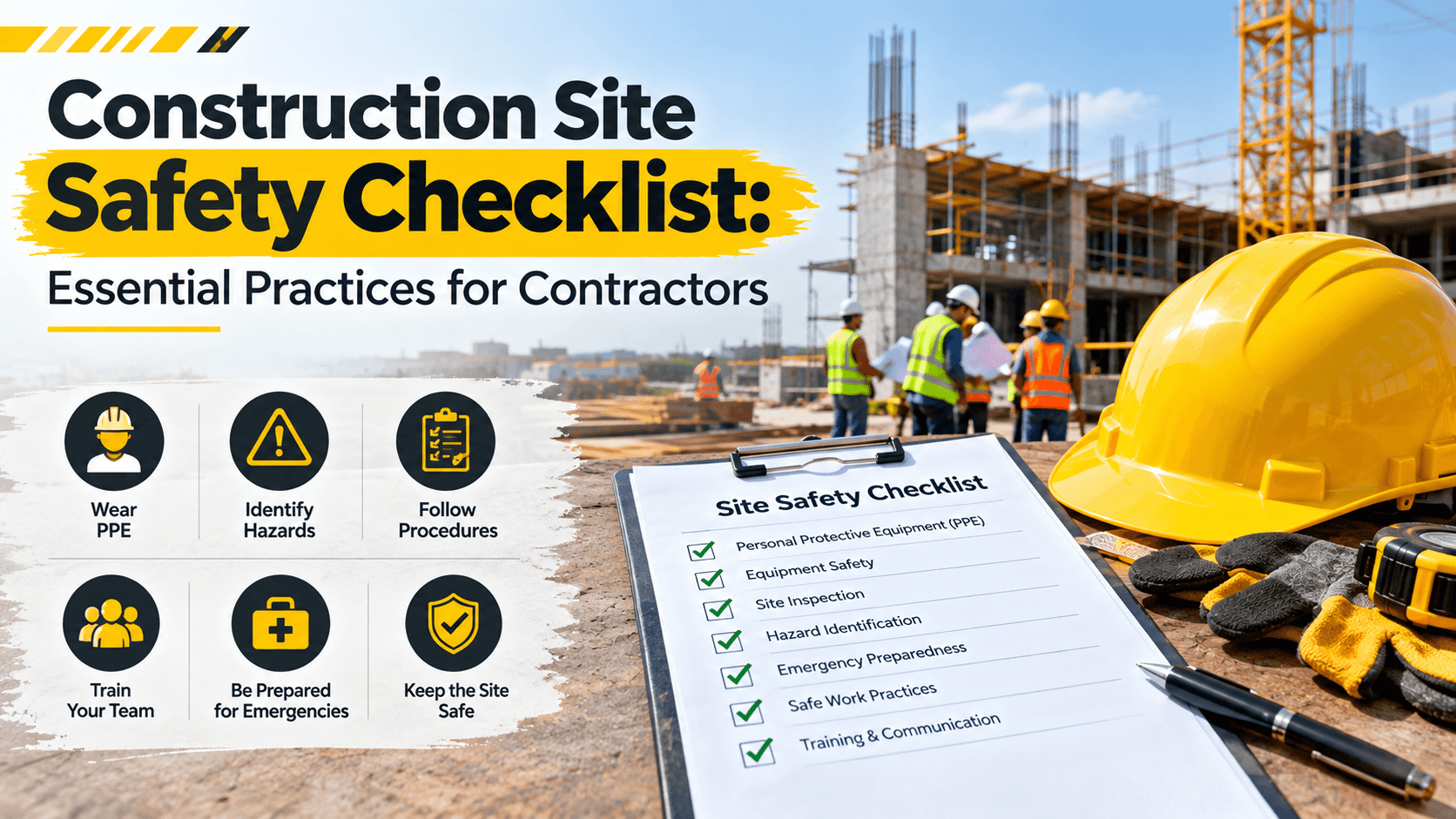
Construction sites bring together workers, machinery, materials, temporary structures, electrical equipment, and multiple activities that may happen at the same time. Without suitable planning and supervision, these conditions can create serious risks for workers, visitors, subcontractors, and the public.
A construction site safety checklist helps contractors review common hazards, assign responsibility, confirm that required precautions are in place, and record problems that need corrective action. It is useful for residential construction, commercial projects, industrial buildings, and infrastructure work.
However, a checklist alone cannot make a site safe. Contractors must also assess the hazards associated with the actual work, provide suitable controls, ensure workers are competent for their tasks, and follow applicable laws and project-specific safety procedures.
This guide covers essential construction safety practices and provides a practical checklist that contractors and site supervisors can adapt to their projects.
1. Why Is Construction Site Safety Important?
Construction work may involve falls from height, moving vehicles, lifting operations, excavations, electrical hazards, falling materials, dust, noise, and heavy equipment.
A structured safety programme helps contractors:
- Identify hazards before work starts.
- Reduce the likelihood of injuries and dangerous incidents.
- Explain safe work procedures to workers and subcontractors.
- Coordinate activities that could create risks for one another.
- Maintain records of inspections, briefings, and corrective actions.
- Protect site visitors and people near the work area.
- Meet applicable legal, contractual, and project safety requirements.
Safety is a shared responsibility, but responsibilities should be clearly assigned. Contractors, employers, site managers, subcontractors, workers, and project owners may have different obligations under the applicable arrangements and laws.
Key principle: Identify the hazard, assess the risk, put suitable controls in place, and verify that the controls remain effective.
2. Construction Site Safety Checklist at a Glance
Use this overview to guide routine site inspections. It is a general checklist, not a complete risk assessment or substitute for legally required inspections.
| Safety area | What to check | Warning signs |
|---|---|---|
| Site access | Entry controls, visitor arrangements, safe routes | Uncontrolled entry, blocked paths |
| PPE | Appropriate equipment available and used correctly | Missing, damaged, or unsuitable PPE |
| Working at height | Edge protection, platforms, access, fall protection | Unprotected edges, unsafe access |
| Scaffolding and ladders | Condition, stability, inspection status, correct use | Damaged parts, unstable setup |
| Excavation | Ground conditions, access, protective measures, nearby services | Unprotected excavation, water ingress, ground movement |
| Electrical safety | Temporary wiring, distribution equipment, isolation | Exposed conductors, damaged cables, wet electrical areas |
| Tools and machinery | Guards, condition, operator competence | Missing guards, defects, unauthorized operation |
| Lifting operations | Equipment condition, load path, lifting plan where required | People under suspended loads, unstable loads |
| Housekeeping | Waste, access routes, material storage | Trip hazards, unstable stacks, blocked exits |
| Fire prevention | Hot-work controls, ignition sources, suitable equipment | Uncontrolled sparks, blocked fire access |
| Health and environment | Dust, noise, heat, ventilation, hazardous substances | Uncontrolled exposure, unsafe storage |
| Emergency readiness | First aid, alarms, emergency contacts, evacuation routes | Missing supplies, unclear procedures |
| Records and briefings | Risk assessments, permits where required, inspection records | Missing documentation, repeated unresolved defects |
3. Site Entry, Access Control and Safety Signage
The site should have a clear system for controlling entry and helping people understand the hazards present.
Contractor checklist
- Establish designated entry and exit points.
- Explain site rules to workers, subcontractors, and visitors.
- Provide suitable visitor authorization and escort arrangements where necessary.
- Display required warning signs and mandatory PPE notices.
- Keep pedestrian routes separated from moving vehicles where practicable.
- Provide safe access to work areas, storage areas, and welfare facilities.
- Secure hazardous or restricted areas against unauthorized entry.
- Keep emergency exits and access routes clear.
- Review temporary access arrangements as the site changes.
Common mistakes
- Allowing visitors to enter active work areas without briefing or supervision.
- Storing materials in pedestrian routes.
- Leaving excavations or hazardous equipment accessible to unauthorized people.
- Failing to update signs when the work layout changes.
Safety signs support a safety system; they do not replace physical barriers, safe work methods, or supervision.
4. Personal Protective Equipment (PPE)
Personal protective equipment helps reduce exposure to hazards when selected, fitted, maintained, and used correctly. PPE should be chosen according to the task and the site's risk assessment.
Common PPE considerations
Safety helmets: Use suitable head protection where there is a risk of head injury. Inspect it for damage and follow the manufacturer's replacement guidance.
Safety footwear: Select footwear appropriate to the hazards, such as impact, puncture, slipping, or other site-specific risks.
High-visibility clothing: Use where workers need to be visible to vehicle operators or equipment users.
Eye and face protection: Select appropriate protection for cutting, grinding, drilling, chemical handling, or work that creates flying particles.
Hand protection: Choose gloves suitable for the material and task. Gloves are not appropriate for every activity, particularly where they could become entangled in rotating equipment.
Hearing protection: Use suitable protection where noise assessments or site controls indicate it is required.
Respiratory protection: Select suitable protection for the identified airborne hazard, and ensure appropriate fit, maintenance, and use arrangements.
Fall-protection equipment: Where required, use an appropriate fall-protection system with suitable anchorage, inspection, training, and rescue arrangements.
PPE inspection checklist
- Confirm the equipment is appropriate for the task.
- Check for visible damage, deterioration, or contamination.
- Ensure workers understand how to wear, adjust, and maintain it.
- Replace defective equipment.
- Provide task-specific instruction where necessary.
- Keep records where required by the safety management system or applicable rules.
PPE is not a substitute for eliminating a hazard or installing effective collective protection where these measures are reasonably practicable and appropriate.
5. Working at Height Safety
Falls from height can cause fatal or life-changing injuries. Work at height includes activities where a person could fall and suffer injury, including some work near openings, edges, fragile surfaces, and elevated platforms.
Before work starts
- Identify fall hazards and assess the planned work.
- Consider whether the work can be completed from a safer location or without working at height.
- Use suitable platforms, guardrails, or other collective protection where practicable.
- Confirm that access equipment is appropriate for the task.
- Protect floor openings, shafts, and other fall hazards.
- Provide suitable fall-protection systems where required.
- Confirm that workers are trained and authorized.
- Plan for rescue if a fall-arrest system is used.
Watch for these hazards
- Unprotected roof edges.
- Incomplete floor edges.
- Open stairwells and service shafts.
- Fragile roofing or skylights.
- Makeshift platforms.
- Improperly secured ladders.
- Unsafe work from scaffolding or elevated equipment.
Do not assume a roof, skylight, temporary platform, or sheet surface can support a person's weight. Work at height must follow the applicable safety procedures, equipment instructions, and site-specific assessment.
6. Scaffolding, Ladders and Temporary Access
Scaffolds and ladders provide access but can become dangerous if damaged, incorrectly assembled, overloaded, or used for unsuitable tasks.
Scaffolding checklist
- Ensure scaffolding is erected, altered, and dismantled by competent personnel.
- Check that the structure is suitable for the intended load and use.
- Confirm that required guardrails, toe boards, platforms, and access arrangements are in place.
- Check the base, support, ties, and stability according to the design and site requirements.
- Keep platforms free from unnecessary debris and materials.
- Do not remove structural components or guardrails without authorization.
- Ensure required inspections are completed and recorded.
- Prevent use where the scaffold is incomplete, damaged, or unsafe.
Ladder checklist
- Use ladders suitable for the work and in good condition.
- Place them on a stable surface and secure them where required.
- Maintain safe access and avoid overreaching.
- Do not use damaged ladders.
- Avoid using ladders as a substitute for a proper work platform where the task requires safer access.
- Keep ladders away from electrical hazards unless the work arrangement has been specifically assessed and made safe.
The correct inspection requirements and frequency depend on the equipment, use, and applicable regulations.
7. Excavation and Foundation Work Safety
Excavations can collapse suddenly. Other hazards include falls into the excavation, falling materials, underground utilities, water ingress, hazardous atmospheres, and movement of nearby structures or equipment.
Excavation safety checklist
- Identify underground services before digging.
- Assess soil and ground conditions.
- Provide suitable protective measures against collapse where required.
- Establish safe access and exit arrangements.
- Keep spoil, materials, and equipment a safe distance from edges as determined by the risk assessment.
- Protect the excavation against unauthorized entry.
- Assess nearby buildings, roads, foundations, and structures.
- Control water ingress and inspect for signs of ground movement.
- Keep heavy vehicles away from edges where their loads could create instability.
- Inspect the excavation after conditions change and as required by the site procedure.
Stop work and reassess if you observe
- Cracking or movement near the excavation edge.
- Soil falling from the sides.
- Unexpected water ingress.
- Movement of nearby structures.
- Damaged underground services.
- Signs of an unsafe atmosphere in an area where such hazards may occur.
Never enter an excavation that has not been assessed and made safe. Protective systems must be appropriate to the excavation and the conditions present.
8. Electrical Safety on Construction Sites
Temporary power, portable tools, exposed conductors, damaged cables, and wet conditions can create severe electrical hazards.
Electrical safety checklist
- Have electrical installations and work handled by qualified and authorized personnel.
- Check for visible damage to cables, plugs, enclosures, and distribution equipment.
- Protect temporary cables from vehicles, sharp edges, water, and mechanical damage.
- Use suitable protective devices and earthing arrangements as required by the system and applicable standards.
- Keep electrical equipment appropriate for the environment.
- Prevent unauthorized access to electrical panels and equipment.
- Use the required isolation and lockout procedures before maintenance or repair.
- Keep electrical equipment away from uncontrolled water exposure.
- Remove defective equipment from service and report it.
- Arrange required inspection and testing.
Do not touch exposed conductors or damaged electrical equipment. If an electrical hazard is suspected, keep people away and arrange for qualified personnel to make the area safe.
9. Tools, Machinery and Construction Equipment
Tools and machinery can create hazards through moving parts, unexpected startup, flying materials, noise, vibration, and improper use.
Checklist
- Use equipment suitable for the task.
- Check tools before use for visible damage or defects.
- Ensure required guards and safety devices are in place.
- Allow only trained and authorized personnel to operate equipment.
- Follow manufacturer instructions and site procedures.
- Keep people away from moving parts and operating zones.
- Isolate equipment before cleaning, adjustment, or maintenance where required.
- Use appropriate lifting and handling methods for heavy equipment.
- Remove defective tools from service until they are properly repaired or replaced.
- Keep maintenance records where required.
Never bypass a machine guard or safety device simply to speed up the work.
10. Lifting Operations and Material Handling
Cranes, hoists, forklifts, and other lifting equipment require planning and controlled operation. Poorly planned lifts can endanger workers and damage structures or materials.
Lifting safety checklist
- Confirm the lifting equipment and accessories are suitable for the load.
- Check inspection and certification records where required.
- Ensure operators and rigging personnel have the necessary competence and authorization.
- Plan the lift according to the load, equipment, environment, and risk.
- Check the ground or supporting surface for suitability.
- Establish an exclusion zone where required.
- Keep people clear of suspended loads.
- Use suitable communication between operators and the lifting team.
- Check weather conditions where they affect lifting safety.
- Stop the lift if visibility, stability, communication, or other critical conditions become unsafe.
For heavy, complex, or unusual lifts, use a suitable documented lifting plan and competent personnel as required by the work and applicable rules.
11. Housekeeping and Material Storage
Poor housekeeping creates trip hazards, obstructed access, falling-object risks, fire hazards, and difficulties during emergency evacuation.
Housekeeping checklist
- Keep walkways and access routes clear.
- Remove waste and debris regularly.
- Store tools and equipment in designated locations.
- Stack materials securely and within safe limits.
- Keep heavy materials on suitable, stable surfaces.
- Secure materials that could roll, slide, or fall.
- Separate pedestrian routes from vehicle routes where practicable.
- Keep exits, fire equipment, and emergency access points unobstructed.
- Manage nails, sharp offcuts, broken materials, and scrap safely.
- Keep work areas clean enough to identify hazards promptly.
Housekeeping should be continuous, not limited to the end of the working day.
12. Fire Prevention and Hot Work
Welding, cutting, grinding, temporary electrical equipment, fuel storage, and combustible waste can create fire hazards.
Fire safety checklist
- Identify ignition sources and combustible materials.
- Follow the site's hot-work permit procedure where required.
- Remove or protect combustible materials before hot work.
- Provide suitable fire-extinguishing equipment and trained personnel as required.
- Maintain safe storage and handling arrangements for flammable substances and gas cylinders.
- Check that escape routes and emergency access remain clear.
- Apply required gas-cylinder storage and separation procedures.
- Arrange fire watch and post-work checks where the risk assessment or permit requires them.
- Ensure workers know how to raise the alarm and report a fire.
- Keep emergency response arrangements suitable for the site.
Do not carry out hot work where the required precautions, authorization, or emergency arrangements are missing.
13. Dust, Noise, Heat and Hazardous Substances
Construction work can expose workers to dust, noise, vibration, heat, fumes, chemicals, and other health hazards. The correct controls depend on the material, process, duration, and exposure level.
Health and exposure checklist
- Identify substances and processes that could harm workers.
- Use safer materials or methods where practicable.
- Control dust at the source, using suitable extraction or suppression methods.
- Avoid dry sweeping or other methods that unnecessarily spread hazardous dust.
- Assess noise and vibration exposure where relevant.
- Provide appropriate hearing protection and other controls where needed.
- Store chemicals according to their labels and safety information.
- Label containers and prevent incompatible substances from being mixed.
- Provide appropriate ventilation for the task.
- Establish suitable hygiene, washing, and welfare arrangements.
- Plan work-rest arrangements and access to drinking water during hot conditions.
- Train workers on the relevant hazards and emergency procedures.
In hot weather, contractors should consider heat exposure, acclimatization, hydration, rest, shade, and emergency response. Suitable measures depend on conditions and the work being performed.
14. Rebar, Formwork and Concrete Work
Reinforcement, temporary formwork, concrete placement, and stripping operations introduce risks such as impalement, collapse, falling materials, manual-handling injuries, and contact with wet concrete.
Checklist
- Protect exposed reinforcement ends where they create an impalement hazard.
- Ensure formwork and temporary supports are designed, installed, and checked for the intended loads.
- Do not alter temporary supports without authorization.
- Keep unauthorized personnel clear of concrete placement and stripping zones.
- Follow the approved sequence for placing and removing formwork.
- Use suitable equipment and methods to handle reinforcement and concrete materials.
- Provide appropriate protection against contact with wet concrete.
- Maintain safe access around pumps, mixers, and delivery vehicles.
- Control the work area during lifting and movement of reinforcement cages.
- Stop work if formwork shifts, bulges, or shows other signs of instability.
Temporary works can be critical to safety. Their design, checking, inspection, and release should be handled according to the project requirements and applicable procedures.
15. Emergency Preparedness and First Aid
A construction site should have a clear response plan for foreseeable emergencies. The arrangements must reflect the site size, location, work activities, and available emergency services.
Emergency checklist
- Display relevant emergency contact information.
- Establish a clear method for raising an alarm.
- Identify evacuation routes and assembly points.
- Keep emergency access routes unobstructed.
- Provide appropriate first-aid arrangements and trained personnel as required.
- Ensure workers know how to report incidents and near misses.
- Establish procedures for fire, serious injury, electrical incidents, and other credible emergencies.
- Plan rescue arrangements for high-risk work where necessary.
- Make sure workers and subcontractors understand the emergency plan.
- Review the plan after significant site changes or an incident.
An emergency plan should be practical and communicated before it is needed. Do not rely on workers improvising a rescue during a high-risk incident.
16. Worker Training, Toolbox Talks and Safety Communication
Safety procedures are effective only when workers understand them and can follow them.
Before work starts
- Explain the hazards and controls relevant to each task.
- Provide site induction for new workers and visitors as appropriate.
- Confirm that workers have the competence and authorization needed for their activities.
- Explain PPE requirements and limitations.
- Communicate emergency procedures.
- Discuss interactions between different trades and work zones.
- Provide additional instruction when equipment, methods, or site conditions change.
Toolbox talks
Short, task-specific safety discussions can address topics such as working at height, excavation, lifting, electrical hazards, housekeeping, heat exposure, and the day's work sequence.
Record attendance and key actions where required by the site's safety management arrangements. Workers should have a clear way to report hazards and stop unsafe work according to the site's procedures.
17. Daily Construction Site Safety Inspection Checklist
The following is a practical starting point for daily checks. Add items based on the site's risk assessment, method statements, permit requirements, and legal obligations.
Before work begins
- [ ] Review planned tasks and identify hazards.
- [ ] Confirm workers have the required induction and task-specific instructions.
- [ ] Check PPE availability and condition.
- [ ] Inspect access routes and work areas.
- [ ] Check that required barriers, signs, and edge protection are in place.
- [ ] Review equipment condition and any outstanding defects.
- [ ] Confirm required permits and authorizations are in place.
- [ ] Check weather or site conditions that could affect safety.
- [ ] Communicate relevant emergency procedures.
- [ ] Confirm high-risk activities have the necessary controls and competent supervision.
During work
- [ ] Check that workers follow the agreed safe work procedures.
- [ ] Keep pedestrian routes and emergency access clear.
- [ ] Monitor work at height, lifting, excavation, and electrical activities as relevant.
- [ ] Watch for interactions between vehicles, machinery, and people.
- [ ] Remove or control newly identified hazards.
- [ ] Stop unsafe work and escalate serious concerns.
- [ ] Record incidents, near misses, and significant changes in conditions.
At the end of work
- [ ] Secure tools, machinery, and materials.
- [ ] Remove waste and control remaining hazards.
- [ ] Secure excavations and restricted work areas.
- [ ] Isolate equipment where required.
- [ ] Store flammable or hazardous substances safely.
- [ ] Leave emergency routes accessible.
- [ ] Record defects and assign corrective actions.
- [ ] Communicate outstanding hazards to the next shift or responsible team.
The checklist should be completed by the person assigned to the task, using the site's actual inspection and reporting procedures.
18. Weekly or Periodic Site Safety Review
Daily observations do not replace more detailed reviews of equipment, temporary works, documentation, and recurring hazards.
A periodic review may include:
- Reviewing inspection records and outstanding corrective actions.
- Checking the condition of access equipment and scaffolding according to required inspection arrangements.
- Reviewing excavation protection and changes in ground conditions.
- Checking temporary electrical arrangements and reported defects.
- Reviewing lifting equipment records and upcoming lifting operations.
- Confirming that emergency routes, first-aid arrangements, and fire precautions remain suitable.
- Checking the storage of materials and hazardous substances.
- Reviewing worker training and authorization records.
- Investigating repeated near misses or recurring unsafe conditions.
- Updating risk assessments when work methods or site conditions change.
Set inspection frequency according to the activity, equipment instructions, risk assessment, and applicable regulations. Some inspections must occur at specified stages or intervals and should not be replaced by a general weekly review.
19. How to Record and Correct Safety Issues
Identifying a hazard is only the first step. The site team must decide what action is needed, who is responsible, and how the corrective action will be verified.
A safety observation register can include:
| Field | What to record |
|---|---|
| Date and time | When the hazard was identified |
| Location | Exact area or activity |
| Hazard | Factual description of the unsafe condition |
| Potential consequence | What could happen if it remains uncontrolled |
| Immediate action | Stop work, restrict access, isolate equipment, or another suitable control |
| Responsible person | Person assigned to resolve the issue |
| Target date | Deadline for corrective action |
| Verification | How the team will confirm the issue is resolved |
| Closure date | When the action was verified and closed |
Example entry
Location: Stairwell opening on an upper floor
Observation: Opening lacks the required protective barrier.
Immediate action: Stop access to the affected area and arrange appropriate temporary protection.
Responsible person: Assigned site supervisor or other designated responsible person.
Verification: Confirm that the required protection is installed and checked before the area is reopened.
This example is illustrative. The appropriate response depends on the actual hazard and site procedure.
For imminent danger, do not wait for routine paperwork. Stop the affected activity, keep people away, and implement the required immediate controls.
20. Common Construction Site Safety Mistakes
Mistake 1: Treating PPE as the complete safety plan
Helmets and safety shoes do not prevent every hazard. Plan work to eliminate or control hazards at their source wherever practicable.
Mistake 2: Starting high-risk work without proper planning
Work at height, excavation, lifting, and hot work may require specific assessments, competent personnel, protective systems, and authorization.
Mistake 3: Ignoring near misses
Near misses can reveal weaknesses in the safety system. Record them, investigate contributing factors, and take corrective action.
Mistake 4: Using damaged tools or equipment
Remove defective equipment from service and arrange appropriate repair or replacement.
Mistake 5: Allowing poor housekeeping
Debris, loose materials, and blocked routes can create avoidable hazards throughout the workday.
Mistake 6: Relying only on verbal instructions
Important responsibilities, inspection results, permits, and corrective actions should be documented where required.
Mistake 7: Failing to coordinate subcontractors
Different trades can create hazards for each other. Coordinate work areas, sequences, access, and high-risk activities.
Mistake 8: Ignoring changing site conditions
Rain, heat, excavation progress, temporary works, and changes in work sequence can affect risk. Review controls when conditions change.
Mistake 9: Bypassing safety devices to save time
Do not remove guards, bypass interlocks, or ignore fall protection to speed up a task.
Mistake 10: Closing a safety observation without verification
An action should be closed only when the responsible person has confirmed that the hazard has been adequately addressed.
21. Construction Site Safety in Rajasthan: Practical Considerations
Contractors should adapt safety planning to the conditions and activities on each site. In Rajasthan, relevant considerations may include:
Heat exposure: Plan work-rest arrangements, hydration, shade, and suitable responses to signs of heat illness during hot conditions.
Dust: Assess dust from excavation, cutting, drilling, demolition, and material handling. Use appropriate controls and protective measures.
Seasonal rainfall: Review excavations, temporary access, electrical equipment, drainage, and slippery surfaces when rainfall affects the site.
Wind: Assess work at height, scaffolding, lifting operations, and unsecured materials when wind conditions could affect stability or control.
Remote or industrial sites: Plan emergency access, communications, first aid, and coordination with available emergency services.
These are planning considerations, not a substitute for site-specific risk assessment. The measures required will depend on the actual conditions, work activities, and applicable regulations.
22. How to Build a Practical Site Safety Plan
A useful site safety plan should reflect the actual project rather than relying entirely on a generic template.
Step 1: Identify activities. List construction tasks, equipment, materials, and high-risk work.
Step 2: Assess hazards. Consider who could be harmed, how incidents could occur, and how serious the consequences could be.
Step 3: Choose controls. Prioritize eliminating hazards and using effective engineering and organizational controls before relying only on PPE.
Step 4: Assign responsibilities. Identify who supervises work, inspects equipment, issues permits where required, and closes safety observations.
Step 5: Brief the workforce. Communicate hazards, controls, emergency arrangements, and reporting procedures in a language and format workers understand.
Step 6: Inspect and document. Use task-specific checklists, inspection records, and corrective-action logs.
Step 7: Review changes. Reassess safety when the site layout, work sequence, equipment, weather, or workforce changes.
Step 8: Learn from incidents. Investigate incidents and near misses, address underlying causes, and update procedures as needed.
23. Final Construction Site Safety Checklist for Contractors
Use this summary before a shift, inspection, or planned review. Mark each item as complete, not applicable, or requiring follow-up.
Site management - [ ] Site entry and visitor controls are suitable. - [ ] Workers understand the site rules and task hazards. - [ ] Work areas and pedestrian routes are organized. - [ ] Required signs and barriers are in place.
PPE and work at height - [ ] Task-appropriate PPE is available and used correctly. - [ ] Edges, openings, and fall hazards are protected. - [ ] Access equipment is suitable and checked as required. - [ ] Fall-protection and rescue arrangements are appropriate where needed.
Excavation, electrical and equipment - [ ] Excavations and underground-service risks have been assessed. - [ ] Required excavation protection and safe access are provided. - [ ] Electrical equipment and temporary wiring have no known unresolved defects. - [ ] Tools and machinery have appropriate guards and controls. - [ ] Lifting activities are planned and controlled.
Housekeeping and health - [ ] Walkways and emergency routes are clear. - [ ] Materials are stored safely. - [ ] Dust, noise, heat, and hazardous substances are controlled appropriately. - [ ] Waste is removed or stored safely. - [ ] Fire precautions and hot-work controls are in place where required.
Emergency readiness and records - [ ] First-aid and emergency arrangements are suitable. - [ ] Workers know how to report hazards and incidents. - [ ] Required inspections and permits are documented. - [ ] Outstanding safety issues have responsible persons and target dates. - [ ] Corrective actions are verified before closure.
Conclusion
Construction site safety is an ongoing process, not a one-time inspection. Contractors need to identify hazards, plan work, provide suitable controls, train workers, coordinate subcontractors, and verify that safety measures remain effective as the site changes.
A practical construction site safety checklist helps teams review common hazards and keep track of corrective actions. It should be used alongside project-specific risk assessments, safe work procedures, equipment inspections, and the applicable legal requirements.
The most important rule is simple: do not allow work to continue when a serious hazard remains uncontrolled. Stop the affected activity, make the area safe, and resume only when the necessary controls are in place.
For construction projects, safety should be considered from planning and site setup through execution, inspection, and handover—not added as an afterthought.
Disclaimer: This article provides general educational guidance. It is not a complete safety plan, risk assessment, permit-to-work system, or legal compliance checklist. Contractors must follow applicable laws, project requirements, equipment instructions, and competent professional advice for the actual site and work activities.