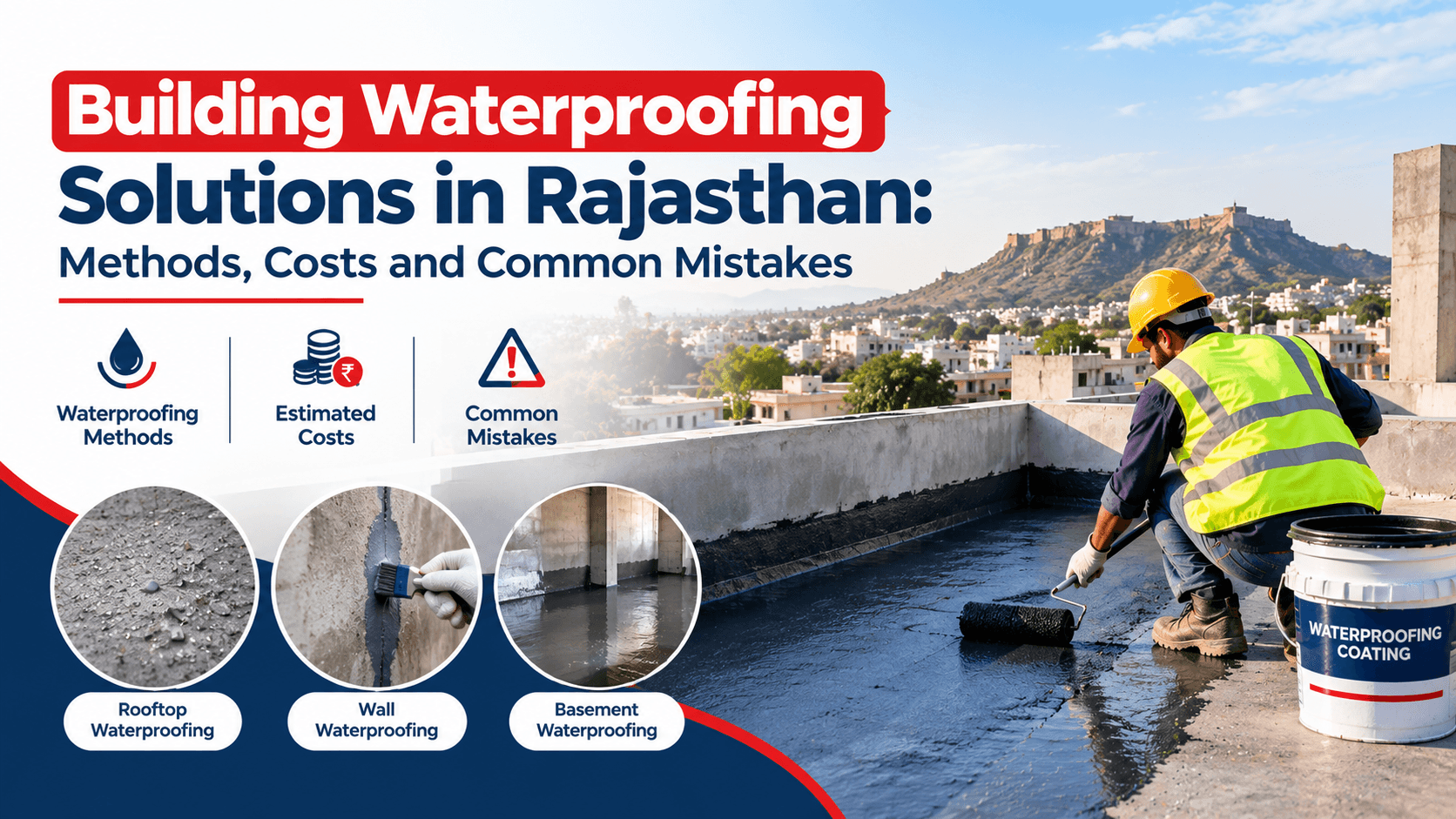
Waterproofing is an important part of building construction and maintenance. Water entering through a roof, terrace, bathroom, external wall or basement can damage paint and plaster, affect interior finishes and create recurring repair costs. If moisture is left untreated, it may also contribute to corrosion of embedded metal components or deterioration of building materials.
For buildings in Rajasthan, waterproofing decisions should account for the specific site, roof design, drainage arrangements, building use and exposure to weather. Hot, dry periods do not eliminate the need for waterproofing; seasonal rainfall, water storage, plumbing leaks and poorly drained surfaces can still cause problems.
The most effective approach is to identify the source of moisture, prepare the surface properly and select a compatible waterproofing system. Applying a coating over a damp or damaged surface without investigating the cause may only hide the symptoms temporarily.
This guide explains common building waterproofing solutions in Rajasthan, the methods used for different areas, the factors that affect costs and the mistakes property owners should avoid.
1. What Is Building Waterproofing?
Building waterproofing is the process of preventing unwanted water from entering or passing through a building element. Depending on the location, it may involve membranes, cementitious coatings, liquid-applied systems, waterstops, joint treatments, drainage improvements or other compatible construction measures.
Waterproofing is different from simply applying water-resistant paint. A suitable system must be designed for the type of exposure, the substrate, movement at joints and the way water will be directed away from the building.
Why is waterproofing important?
A properly designed and installed waterproofing system can help:
- Reduce water penetration through roofs, terraces and wet areas.
- Protect interior finishes from moisture damage.
- Reduce the likelihood of recurring leakage repairs.
- Protect suitable building components from prolonged water exposure.
- Support more durable construction when coordinated with drainage and detailing.
- Improve the reliability of new construction and renovation work.
Waterproofing does not compensate for every construction defect. Structural cracks, plumbing leaks, condensation and poor drainage may require different or additional corrective measures.
2. Common Waterproofing Problems in Buildings
Before selecting a product or method, determine where the water is coming from. Similar-looking stains can have different causes.
2.1 Roof and terrace leakage
Water may enter through cracks, poorly sealed joints, defective waterproofing layers, damaged outlets or areas where water remains ponded.
What to investigate: Roof slopes, rainwater outlets, parapet junctions, service penetrations, existing membrane condition and visible cracks.
2.2 Bathroom and toilet leakage
Water can escape through poorly detailed floor-wall junctions, pipe penetrations, damaged joints or defective waterproofing beneath the finish.
What to investigate: Plumbing connections, concealed pipe leaks, floor traps, wall-floor junctions and the condition of the waterproofing layer.
2.3 Dampness on external walls
Rain penetration, failed sealants, cracks, exposed masonry and defective window or balcony junctions can allow moisture to enter.
What to investigate: Exterior cracks, window perimeters, ledges, parapets, cladding joints and water runoff paths.
2.4 Rising damp or moisture near the floor
Moisture at the bottom of a wall may be associated with ground moisture, missing or failed damp-proofing, external ground levels, leaking services or other sources.
What to investigate: Ground levels, drainage, damp-proofing details, plumbing and the distribution of moisture. A surface coating alone may not address the underlying cause.
2.5 Basement and below-ground seepage
Below-ground walls and floors can be exposed to soil moisture, groundwater pressure or water entering through joints and penetrations.
What to investigate: Site drainage, groundwater conditions, construction joints, wall-floor junctions, service entries and the original waterproofing design.
2.6 Plumbing-related leakage
A concealed water-supply pipe, waste pipe or tank connection may leak and create damp patches that resemble waterproofing failure.
What to investigate: Plumbing tests, water-meter behaviour where relevant, tank and pipe connections, and the location of moisture relative to service routes.
Correct diagnosis matters because applying a roof or wall coating will not fix a leaking pipe or a condensation problem.
3. Common Building Waterproofing Methods
Different methods serve different purposes. Product selection should follow the substrate condition, expected movement, water exposure, installation requirements and manufacturer's technical instructions.
3.1 Cementitious waterproofing
Cementitious waterproofing products are applied to prepared concrete or masonry surfaces according to the system specification. Some are designed for wet areas and certain water-exposure conditions.
Common applications: Selected bathrooms, utility areas, water-retaining structures and other compatible substrates.
Advantages: - Can bond well to properly prepared mineral surfaces. - Can be suitable for certain internal wet-area applications. - Some systems are straightforward to apply to suitable surfaces.
Limitations: - Flexibility and crack-bridging capacity vary by product. - Moving joints and significant cracks need appropriate detailing. - The system must be suitable for the expected water pressure and exposure.
Do not assume every cementitious coating is suitable for every terrace, tank or basement.
3.2 Liquid-applied waterproofing membranes
These systems are applied in liquid form and cure to create a continuous waterproofing layer. The chemistry may vary, including acrylic, polyurethane or other specified formulations.
Common applications: Selected roofs, terraces, balconies and exposed or covered surfaces where the chosen product is suitable.
Advantages: - Can form a continuous layer around suitably detailed shapes. - May be useful where there are multiple edges or penetrations. - Certain systems can accommodate limited movement.
Limitations: - Performance depends on surface preparation, application thickness and curing. - Weather, moisture and temperature restrictions may apply during installation. - Not all products are suitable for permanent ponding, ultraviolet exposure or foot traffic.
Follow the product's specified primer, reinforcement, thickness and curing requirements.
3.3 Sheet membranes
Sheet membranes are manufactured in rolls or sheets and installed with specified laps, joints, terminations and detailing. The material may be bituminous, synthetic or another system type.
Common applications: Selected terraces, roofs, foundations and below-ground structures.
Advantages: - Factory-controlled sheet thickness. - Can provide a consistent barrier when installed correctly. - Suitable systems are available for different exposure conditions.
Limitations: - Laps, corners, penetrations and terminations require careful workmanship. - Poor detailing can create leakage paths. - Compatibility with the substrate, protection layer and finishes must be checked.
3.4 Bituminous waterproofing
Bituminous products may be used in membrane or coating systems for specified building applications. Their suitability depends on the exact formulation and system design.
Common applications: Selected roofs, foundations and below-ground waterproofing assemblies.
Advantages: - Established options are available for various exposure conditions. - Some systems work well as part of a specified layered assembly.
Limitations: - Some products require protection from sunlight or mechanical damage. - Installation may require specialised procedures and safety controls. - The correct system must be selected for the location and service conditions.
3.5 Integral waterproofing admixtures
Certain admixtures are added to concrete or mortar during production to modify specific properties related to water penetration.
Common applications: Suitable concrete work where the admixture is part of an engineered mix and construction specification.
Advantages: - Incorporated into the specified concrete or mortar mix. - May complement a broader waterproofing strategy.
Limitations: - Does not automatically make a structure fully waterproof. - Crack control, joints, concrete quality, curing and workmanship remain important. - Product dosage and compatibility must follow technical guidance.
3.6 Joint sealing and crack repair
Joints and cracks may need dedicated sealants, waterstops, injection systems or repair materials. The correct treatment depends on whether the crack is active, its cause, the substrate and whether water is under pressure.
Important: A crack that indicates possible structural movement should be assessed by a qualified professional before cosmetic repair or waterproofing work proceeds.
3.7 Drainage and water-management improvements
Waterproofing is not only about applying a membrane. Proper roof falls, rainwater outlets, site drainage, flashing, drip edges and discharge arrangements help prevent water from accumulating or entering vulnerable junctions.
Where possible, correct drainage defects and water sources alongside the waterproofing work rather than relying on a coating alone.
4. Which Waterproofing Method Is Suitable for Each Area?
The right choice depends on the exact assembly, exposure and condition of the building.
| Building area | Common approaches | Important checks |
|---|---|---|
| Roof or terrace | Compatible liquid-applied or sheet membrane systems | Slope, outlets, ponding, parapets and penetrations |
| Bathroom or toilet | Wet-area membrane with specified junction and penetration detailing | Plumbing, floor trap, wall-floor junction and finish compatibility |
| External walls | Suitable crack repairs, sealants, coatings or facade systems | Rain exposure, cracks, windows and ledges |
| Basement | Designed below-ground membrane, joint treatment and drainage measures | Groundwater conditions, water pressure, joints and penetrations |
| Water tank | System specifically approved for the tank's intended use | Water compatibility, substrate, joints and applicable approvals |
| Foundation | Specified below-ground waterproofing or damp-proofing system | Soil and groundwater conditions, protection and drainage |
This table is a starting point, not a product specification. A site inspection and system-specific design may be necessary for recurring or complex leakage.
5. Waterproofing Considerations for Rajasthan
Waterproofing requirements differ from site to site. Rajasthan includes varied local conditions, building types and exposure levels, so one generic solution should not be used everywhere.
Account for hot weather and surface temperatures
Exposed roofs and terraces may experience high surface temperatures. Some products have restrictions on application temperature, substrate temperature or curing conditions.
Choose a system with suitable service-temperature performance and follow the manufacturer's installation instructions.
Plan for seasonal rainfall and drainage
Roof outlets, rainwater pipes, parapet junctions and terrace slopes should be planned to direct water away efficiently.
A waterproofing membrane may still fail if outlets are blocked, slopes are inadequate or water enters through poorly detailed junctions.
Protect exposed waterproofing layers
Some membranes require screed, tiles, protective boards or another specified protective layer. Other products are designed to remain exposed under defined conditions.
Confirm whether the chosen system needs protection from ultraviolet exposure, foot traffic, tools or subsequent construction activities.
Coordinate with plumbing and electrical work
Pipe penetrations, sleeves, conduits and service routes can create vulnerable points. Coordinate these details before the waterproofing layer is installed and avoid unapproved cutting or drilling afterwards.
Consider the building's use
A private terrace, an accessible roof, a bathroom, an industrial roof and a basement do not have the same performance requirements. Specify the system according to use, traffic, exposure and maintenance access.
6. Waterproofing Cost in Rajasthan: What Affects the Budget?
There is no single reliable waterproofing rate for every building. Costs depend on the location, affected area, existing surface condition, chosen system and the amount of preparation and detailing required.
Main cost factors
1. Area to be treated
The measured area affects material quantities and labour. Small repair jobs may have a higher cost per square metre because mobilisation and preparation are spread across a smaller area.
2. Existing surface condition
Loose plaster, damaged screed, cracks, old coatings or contaminated surfaces may require removal, repair and preparation before waterproofing begins.
3. Waterproofing system
Different membranes, coatings, reinforcement systems and installation methods have different material and labour requirements.
4. Detail work
Pipe penetrations, drains, corners, parapets, joints, movement joints and terminations may need additional materials and skilled labour.
5. Access and working conditions
Roof access, height, scaffolding, restricted working areas, occupied premises and protection of nearby finishes can affect labour and equipment costs.
6. Protective layers and reinstatement
The total scope may include screed, tiles, protective boards, plastering, painting or other reinstatement work after the waterproofing layer is completed.
7. Testing and quality checks
Specified water testing, inspections, documentation and repairs before covering the membrane may add to the project scope. Testing should follow the system requirements and be performed safely.
8. Warranty and maintenance terms
Review what the contractor or manufacturer actually covers, including exclusions, inspection requirements and the conditions that could invalidate the warranty.
How to prepare a more reliable waterproofing estimate
Before comparing quotations:
- Measure the area and identify the affected building elements.
- Record visible damage and the suspected source of water.
- Specify the proposed system and required number of coats or membrane thickness where applicable.
- Include surface preparation, crack repair and junction detailing.
- Clarify whether removal and reinstatement of finishes are included.
- Identify access, protection, testing and cleanup requirements.
- Ask contractors to state material specifications and exclusions.
- Compare quotations for the same scope, not just the final amount.
Request an itemised estimate using the actual site dimensions and required work. Do not compare a basic coating quotation directly with a quotation that includes repairs, detailing, protective layers and testing.
7. Common Waterproofing Mistakes to Avoid
Mistake 1: Treating the visible stain instead of the source
Painting over a damp patch may hide the appearance without stopping the water.
Better approach: Identify whether the cause is rain penetration, a plumbing leak, rising moisture, condensation or another issue before selecting the treatment.
Mistake 2: Applying waterproofing over a poorly prepared surface
Dust, loose material, oil, unsound plaster and incompatible old coatings can affect adhesion.
Better approach: Follow the system's substrate-preparation requirements and repair defective areas first.
Mistake 3: Ignoring roof slopes and drainage
Water that remains ponded can place additional demands on the system and expose weak details.
Better approach: Review the falls, outlets, overflow provisions and discharge path as part of the repair or construction plan.
Mistake 4: Skipping corners and pipe penetrations
A membrane may perform well across a flat area but leak where it meets a pipe, drain, wall or movement joint.
Better approach: Specify and inspect all transitions and penetrations according to the selected system.
Mistake 5: Using the wrong product for the application
An exterior coating may not be suitable for a water-retaining structure, and a product designed for a protected surface may not tolerate prolonged sunlight or foot traffic.
Better approach: Verify intended use, substrate compatibility, exposure limitations and manufacturer guidance.
Mistake 6: Covering the membrane too early
Premature tiling, screeding or backfilling can damage a layer that has not cured or passed required checks.
Better approach: Follow the installation sequence, curing times, protection requirements and specified inspection or testing procedures.
Mistake 7: Applying too little material or uneven thickness
Insufficient coverage can compromise the intended system performance.
Better approach: Follow the specified consumption rate, number of coats and dry-film or membrane thickness requirements, as applicable.
Mistake 8: Neglecting plumbing and building movement
A waterproofing system cannot reliably resolve an ongoing pipe leak or uncontrolled structural movement by itself.
Better approach: Repair the source and obtain appropriate technical assessment before reinstating the waterproofing system.
Mistake 9: Choosing a contractor on price alone
A low quote may omit preparation, detailing, protective layers or testing.
Better approach: Compare specifications, workmanship, scope, exclusions and warranty terms alongside the price.
Mistake 10: Failing to maintain the roof
Blocked outlets, damaged sealants and later drilling can undermine even a properly installed system.
Better approach: Inspect drainage and visible details periodically, especially before and after the rainy season.
8. New Construction vs Waterproofing Repairs
The best time to plan waterproofing is before the relevant construction element is concealed by finishes or backfilled.
For new construction
- Specify waterproofing in the drawings and project scope.
- Coordinate pipe sleeves, joints, drains and penetrations.
- Ensure the substrate, slope and drainage details are suitable.
- Record the products and installation requirements.
- Inspect and carry out required testing before covering the system.
- Protect completed work from damage by following trades.
For existing buildings
- Map visible leakage and dampness.
- Investigate the source before choosing a repair.
- Remove defective material where required.
- Check whether existing layers are compatible with the proposed treatment.
- Repair drainage, plumbing or other underlying defects.
- Test and document the repair where the system calls for it.
A localised repair may be sufficient for a small, isolated defect. Widespread failure or recurring leakage may require a broader assessment rather than repeated patchwork.
9. Waterproofing Inspection Checklist
Use this checklist when reviewing a new waterproofing installation or planning remedial work.
- Has the source of moisture been investigated?
- Is the substrate sound and properly prepared?
- Have cracks and defective joints been assessed?
- Are roof slopes and drainage outlets adequate?
- Are corners, pipe penetrations and terminations detailed?
- Is the selected product suitable for the actual exposure?
- Are application conditions and curing requirements being followed?
- Are thickness, coverage or coat requirements documented?
- Is the membrane protected from damage during subsequent work?
- Have specified inspections and tests been completed?
- Are product details, installation records and warranty terms available?
- Is a maintenance plan in place for drains and exposed surfaces?
The required inspection and testing method depends on the system and location. For example, water testing must be planned so that it does not overload the structure or cause damage to occupied areas below.
10. How Hindustan Projects Can Support Construction Planning
Waterproofing works best when coordinated with the building design, structural details, drainage, plumbing and construction sequence.
Hindustan Projects (HiPRO) offers construction-related planning and engineering services. Depending on the project and the services confirmed by the team, relevant support may include architectural planning, structural engineering coordination, cost estimation and project management.
Explore these related pages:
- Architecture and Planning
- Structural Engineering and Analysis
- Construction Cost Estimation and BOQ
- Project Management Consultancy
For a new building or renovation, share the project location, affected area, available drawings and the nature of the leakage when discussing your requirements. Confirm directly with HiPRO which waterproofing-related services it currently provides.
11. Final Thoughts
Building waterproofing is not simply a matter of applying a coating to a leaking surface. Long-term performance depends on identifying the source of moisture, selecting a suitable system, preparing the substrate, detailing joints and penetrations, managing drainage and inspecting the work.
For buildings in Rajasthan, account for the actual site conditions, roof exposure, seasonal rainfall, surface temperatures and intended building use. Budget for preparation and detailing as well as the main waterproofing material, and compare quotations on an equivalent scope.
Whether you are planning a new house, a commercial building or repairs to an existing property, early coordination can help reduce avoidable rework and improve the quality of construction decisions.
Planning a construction or renovation project? Contact Hindustan Projects to discuss your project-planning and cost-estimation requirements.
Disclaimer: This article provides general educational information, not a site-specific waterproofing specification. The correct method depends on the source of moisture, substrate, exposure, groundwater conditions where relevant and the selected product system. Recurring leakage, structural cracks and below-ground water ingress may require assessment by qualified professionals.